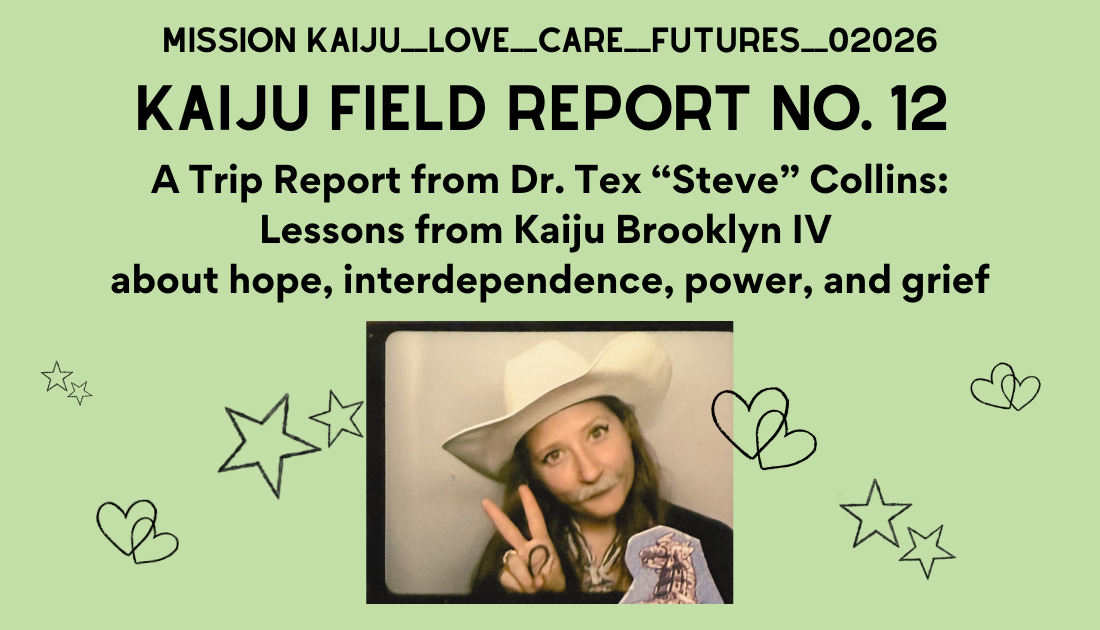
KAIJU FIELD REPORT No. 12
A Trip Report from Dr. Tex "Steve" Collins: Lessons for humanity from Kaiju Brooklyn IV about hope, interdependence, power, and grief.
New to the Mission? START HERE: Kaiju Papers Site Index
INCOMING TRANSMISSION / / /
I appreciate your patience and willingness to extend this Field Report’s deadline, as I needed to tend to confidential birthday business.
I am also grateful that you and the rest of the team at Mission HQ are beginning to take our work here at the Field Office for Mission Kaiju_Love_Care_Futures_02026 more seriously, even if it means that you trust the opinions of other writers more than your own mission team.
Whatever it takes, I suppose.
What follows is a special edition Field Report outlining my learnings from Kaiju Brooklyn IV, an annual Kaiju Convention hosted here in Brooklyn, NY. Since you insisted on sending Egg and I on a Kaiju-spotting trip to Boston (with rationale beyond my comprehension), I could only attend on Saturday, May 30. Still, I was struck by the love, creativity, and kindness I encountered. I distributed zines, high-fives, and thumbs-ups to many new friends.
While conversing with some of these new friends, I asked them, “What do you think Kaiju can teach us about building better futures?” Their answers were poignant, hopeful, and inspiring. In the following pages, I have compiled these answers, my reflections, and some thoughts about how we might move forward.
I look forward to returning to business as normal next week—our next artifact for review is All Monsters Attack (1969).
In other news, I am honored to have been asked to appear on Jurassic Paleoart Expo (JPX)’s Instagram Live Interview Series. Josh Ballze (noted member of The Kaiju Papers’ Arts Department) and I will sit down to discuss his recent dispatch from the year 00326 A.F. (After Fascism), what we can learn from Kaiju about the future, and anything else that comes up. Members of the public are encouraged to tune in on Monday, June 15 at 3p EST, SHARP!
KAIJU FIELD REPORT No. 12
- Date: June 12, 02026
- Location: Industry City, Brooklyn, NY
- Mission: Kaiju_Love_Care_Futures_02026
- Artifacts Examined: Kaiju Brooklyn IV attendees’ answers to the question, “What do you think Kaiju can teach us about building better futures?”
- Rations Consumed: A spanikopita from Sahadi’s, fruit gushers, and electrolytes.
- Chief of Mission (AKA Dudley the Dog) Present? No—Industry City was not a Chief of Mission-friendly area, but the Field Office’s horse provided transportation and waited outside the venue patiently.
This sub-mission would not have been a success without the guidance and friendship of Jacob Lyngle (Kaiju United) and Henry the Host (ICFAMMRebirth Podcast). These brave Kaiju scholars took me under their respective wings and made sure I was in the right place at the right time to meet the right people. In other words, I did not have to work very hard to pretend to be normal. As some of you at Mission HQ know, while I appear to be fiercely independent and look to have the strength of 100 normal men, I do best with a chaperone.
I—and by extension, Mission Kaiju_Love_Care_Futures_02026—owe them a great debt.
The success of this sub-mission is also thanks in part to the inspiration and legacy of my biological fathers, Dr. Indiana Jones and Dr. Ian Malcolm.
I thank all of the citizen-scientists, artists, and thinkers who took a zine, said hello, and stopped to have a chat with me. I also thank everyone who complimented my pants and/or mustache. If we spoke, but you do not see yourself reflected here, it is because when I get overwhelmed I become a terrible notetaker. If you feel I have harmed you and you would like to engage in an accountability process, please get in touch with Egg. He will respond to you within four-to-six business weeks.
Without further ado, I present my learnings and reflections from Kaiju Brooklyn. In this report, you will find quotes collected at Kaiju Brooklyn, related quotes from the Kaiju Papers’ Field Office Library, and my own thoughts.
LESSONS FOR HUMANITY ABOUT PERSISTENCE AND HOPE
“In moments of hardship, there is nothing stronger than kindness and an unrelenting and unwavering ability to see the light in others.”
- Mario Macchiarulo, Author, Kaiju United
There it is—community. As Mariame Kaba offers in a 2018 interview called Hope is a Discipline:
“I don’t believe in self-care: I do believe in collective care, collectivizing our care, and thinking more about how we can help each other … You can just care for yourself and community in tandem, and that can actually be much more healthy for you, by the way. Because all of this internalized reflection is not good for people. Yes, think about yourself, reflect on your practice, okay. But then you need to test it in the world; you’ve got to be with people.” - Kaba, We Do This ‘Til We Free Us, page 28
“Persistence will prevail. Sometimes you have to fight close to death to battle your worst demons. Keep going: you will prevail.”
- MAP & THE BRIGHT HUMANS (Instagram & Spotify)
This brings to mind the necessary conditions for persistence: it is incredibly difficult to persist alone. It is also incredibly difficult to persist without purpose: for what are we persisting? Community and purpose provide fertile soil for persistence—our roots must be nourished if we are to continue growing in a sustainable manner!
“Godzilla teaches us to be bold in our decisions. Seize the moment and advance toward your dreams. Monsters never hesitate.”
- Sean Sumagaysay, Project Nautilus Cosplay
Monsters never hesitate. It's much easier to take action when we know who we are, what our politics are, and—as mentioned above—what our purpose is. Knowing these things, interrogating these things, and staying true to them is, I think, the practice and discipline of hope. I turn again to Mariame Kaba:
“I always tell people, for me, hope doesn't preclude feeling sadness or frustration or anger or any other emotion that makes total sense. Hope isn't an emotion, you know? Hope is not optimism. … The idea of hope being a discipline is something I heard from a nun many years ago who was talking about it in conjunction with making sure we were of the world and in the world. … The hope that she was talking about was this grounded hope that was practiced every day, that people actually practiced all the time.
I bowed down to that. … Because in the world we live in, it’s easy to feel a sense of hopelessness, that everything is all bad all the time, that nothing is going to change ever, that people are evil and bad at the bottom. It feels sometimes that it’s being proven in various different ways, so I really get that. I understand why people feel that way. I just choose differently. I choose to think a different way, and I choose to act in a different way. I choose to trust people until they prove themselves untrustworthy.”- Kaba, Hope is a Discipline, We Do This ‘Til We Free Us, page 26
To move in the way that Sean Sumagaysay and Mariame Kaba are describing, we must know who we are and what we believe in. This is a lifelong discipline! One of humility, curiosity, and love. What might our shared future(s) look and feel like when more of us practice hope as a grounded discipline?
LESSONS FOR HUMANITY ABOUT COEXISTENCE, INTERDEPENDENCE, AND COLLABORATION
“Kaiju movies teach us that cooperation of the masses can lead to a better future.”
- Yoko Higuchi, Resistance Pictures
I can't help but think of the slogan “no war but class war,” as well as a cornerstone of the Field Office’s political analysis: Racecraft: The Soul of Inequality in American Life by Karen E. Fields and Barbara J. Fields. Below I offer their introduction to the book’s fourth chapter, titled Slavery, Race, and Ideology in the United States of America:
“Our analysis of racecraft lays out various mechanisms by which an ideology takes on the appearance of uncontroversial everyday reality—universally understood rituals regarding deference and consumption, self-confirming enactment in practical activities of all kinds, and continuously renewed barriers against the everyday flow of refuting evidence. The roots of witchcraft ideology are ancient, but America’s racecraft ideology is comparatively recent. This chapter establishes how and when it arose. Against the promptings of that ideology, still to be reckoned with inside and outside classrooms, the chapter argues that the assignment of Black Americans to slavery did not follow automatically from their color or ancestry. Rather, it occurred as part of a historical process in which the enslavement of Africans made possible the freedom of Europeans, and then cast a long shadow over subsequent history. Out of that process emerged an elaborate public language of "race " and "race relations " that disguised class inequality and, by the same stroke, impoverished Americans' public language for addressing inequality.” - Fields & Fields, Racecraft, page 111
In other words, race (and racism) is an ideology that serves to uphold white supremacy—a core function of which is to keep those underneath the ruling classes divided.
“Coexistence is possible - it takes a lot of work. We might not see this in our lifetime, but you know what they say about planting trees.”
- Heather Mooch, Radio Free Godzilla
Coexistence IS possible! Not only between humans, but between us and our more-than-human neighbors. “You know what they say about planting trees.” Yes, I do.
If we insist on seeing all of the changes we hope for within our lifetime as a condition for action, we are doomed. We must redefine our ideas of legacy! This speaks to why we at The Kaiju Papers insist on using the Long Now dating system: we are in the year 02026, not 2026. We are at the beginning of a 10,000-year cycle. We are certain we will not see many of the fruits of our labor, but that cannot matter. That said, it is important to note that it's not that we will see no progress. We will see—and have seen—some of the fruits of our labor and the labor of those who came before.
As outlined in Kaiju Field Report No.3: Time and space are big.
I would like to offer a quote from Angela Davis about collective power—something under (or adjacent to) the idea of “coexistence” is the notion of collectivism, of rejecting the idea of the rugged individual. This may come as a surprise, but even I, the great, independent, capable Dr. Tex Collins, cannot do everything on my own.
“Since the rise of global capitalism and related ideologies associated with neoliberalism, it has become especially important to identify the dangers of individualism. Progressive struggles—whether they are focused on racism, repression, poverty, or other issues—are doomed to fail if they do not also attempt to develop a consciousness of the insidious promotion of capitalist individualism. … It is essential to resist the depiction of history as the work of heroic individuals in order for people today to recognize their potential agency as a part of an ever-expanding community of struggle.” - Davis, Freedom is Constant Struggle: Ferguson, Palestine, and the Foundations of a Movement, page 1
What might our shared future(s) look and feel like when we have rejected the idea of the rugged, heroic individual? When we have removed celebrity from our ideas of liberation? A question for the Arts Department!
LESSONS FOR HUMANITY ABOUT UNDERSTANDING OUR POWER
“[Kaiju] show us the hubris of humanity (such as opening doors to the atomic age) and act as a warning.”
- Jay Gordon
As you know (and sometimes seem to judge), we at the Field Office are very interested in time travel. While the future is the focus of our mission, we must also remember our ability to travel to the past. We cannot expect to build futures in which everyone—human and more-than-human—can thrive without understanding the mechanisms and politics that created our current present. To take this further, traveling to the past helps us understand how we might influence our present. After all, we are building the future now, in the present.
For members of the public who are interested in understanding their own power via time travel: I encourage you to travel through space and time guided by the artist Firelei Báez:
“My works are propositions, meant to create alternate pasts and potential futures, questioning history and culture in order to provide a space for reassessing the present.” - Firelei Báez (who just so happens to have a show at Hauser & Wirth’s 22nd St. gallery in Manhattan through July 31.)
“[Kaiju teach us] that we are all different in our own way—and even though we are all different, we can equally destroy a city.”
- Vinny D’Lux, Kaiju Big Battel
We are all different, and we all have power. A resource we at the Field Office return to again and again is NCDI’s Sources of Power one-sheet. We have adapted it into an infographic below:
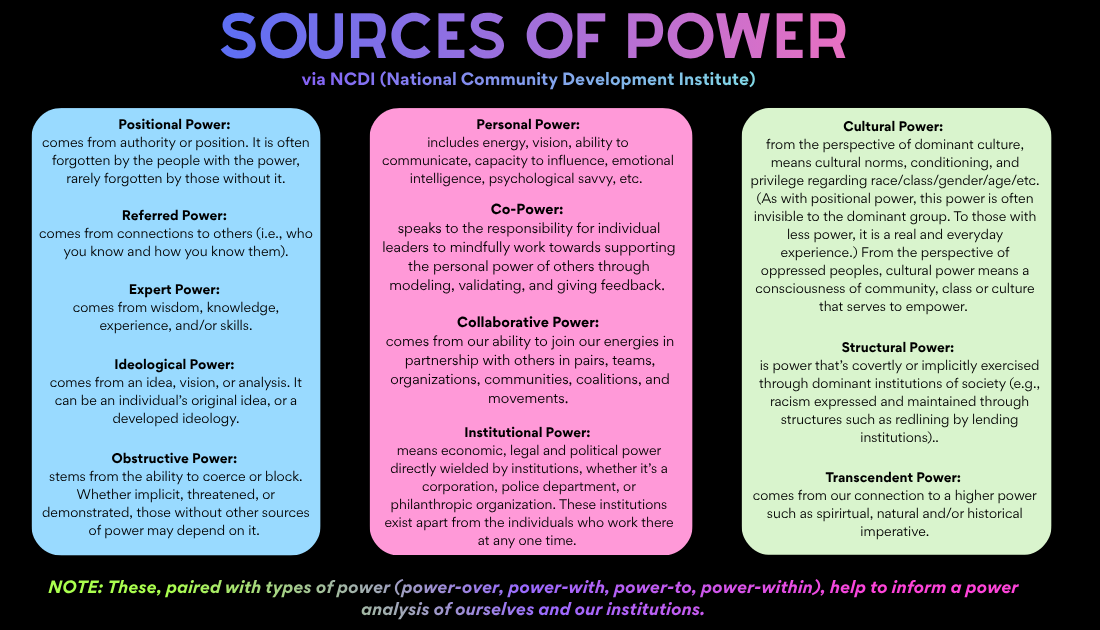
I encourage members of the public to examine the sources of their power and how they wield that power. This is but one resource for understanding power!
If there is appetite, our political analyst, Julije Morrison, is always ready to distribute resources and thoughts about power. Those reading this dispatch are encouraged to let us know if they would like Julije to author a Kaiju Power Primer. The most optimal way to do this is to send a carrier pigeon or two to thekaijupapers@gmail.com with the subject line “yes.”
For lack of a better segue:
Anyway, as Mikaela Loach offers:
“For any action or change to happen, the work of thousands of ordinary people is going on behind the scenes. There are people who write press releases; people who do research; people who provide well-being support and make cups of tea; people who give legal advice and manage social media; people who sort out logistics and organise finance. This list isn;t by any means exhaustive. Actions and campaigns don’t just spring up out of nowhere — they require a huge workforce with a wide variety of skills. All of these roles are valuable.” - Loach, It’s Not That Radical: Climate Action to Transform Our World, page 191
This is all to say: we are not powerless. We can all destroy a city! (hypothetically, of course, if anyone in the Intelligence community is reading this).
What might our shared future(s) look and feel like once we no longer feel powerless? The Arts Department might be able to show us!
LESSONS FOR HUMANITY ABOUT GRIEF & CHANGE
“Kaiju represent change - sometimes that can be benevolent but it’s always growth. Change is not moral.”
- Henry the Host, ICFAMMRebirth Podcast
In change, there is loss. I have found that Kaiju have much to teach us about not only change, but the grief that is inherent in change. The following words from Malkia Devich-Cyril are ones that I return to in each new season of grief. These are passages from Cyril’s chapter in Holding Change by adrienne maree brown—essential reading for anyone interested in facilitation and conflict mediation for social justice. While Cyril’s words here refer directly to social justice movements, I find that these ideas are applicable to our friendships and relationships—grief is deeply, deeply human.
“Our collective disappointment with the imperfections of the movements we build are a reflection of our refusal to grieve the truth that perfection is impossible. Blame refuses grief's complexity and wisdom. Blame forces our eyes in the wrong direction. When blame appears as a pattern, it is in fact a reactionary habit that grows out of society's ritual denial of grief.” - Cyril, Holding Change, page 72
“White supremacy, capitalism, and patriarchy are ideological and structural systems that both beget and reject grief, fuel destructive violence, and keep communities clinging to the old world, clinging to how things were instead of imagining what it could be, clinging to the ideology of control. Attempting to control life is often and attempt to escape death, from which there is no escape. These systems radically distort our relationship to death.
But death belongs; it’s not the burden. Death is a natural part of every life cycle. Our bodies will die. Our organizations will die. Our movements will die. Likewise, the specific conditions that oppress our families and communities will also come to an end. Endings are not to blame. Loss is simply an element of change.” - Cyril, Holding Change, page 74
“Grounded grief is a vaccine against the morbid conditions bred by white supremacy, a patriarchy that has distorted our families and relationships, a concentration of wealth that has disconnected us from nature and directed everything brilliant and beautiful to profit. Only through the compassion and loneliness and love inherent in grief can we forge a world out of the fire that will not replicate ancient hierarchies, nor replace old gods with new ones that are just as arrogant and just as punitive. On either side of change is loss. To reimagine and reshape the world, grief is a skill we need.” - Cyril, Holding Change, page 75
“When we bring our fights to the watering hole of grief, our political systems, natural environment, economic frameworks, civil society, and culture all become living breathing memorials to what we have lost. What we have lost becomes found, witnessed, honored. In this way, all social justice and human rights work is a collective act of gloried mourning.To have a movement that breathes, you must build a movement with the capacity to grieve.” - Cyril, Holding Change, page 79
What might our shared futures look and feel like if we developed the collective capacity to grieve fully and honestly? Another question for the Arts Department.
I am buoyed by my time at Kaiju Brooklyn, and I am grateful for the citizen scientists, researchers, and artists who shared their wisdom about what Kaiju can teach us about building better futures. It feels appropriate to close with an offering from bell hooks in All About Love:
“Awakening to love can happen only as we let go of our obsession with power and domination. … a love ethic presupposes that everyone has the right to be free, to live fully and well.” - hooks, All About Love, page 87
“Domination cannot exist in any social situation where a love ethic prevails. … When love is present the desire to dominate and exercise power cannot rule the day. All the great social movements for freedom and justice in our society have promoted a love ethic. Concern for the collective good of our nation, city, or neighbor rooted in the values of love makes us all seek to nurture and protect that good. If all public policy was created in the spirit of love, we would not have to worry about unemployment, homelessness, schools failing to teach children, or addiction.” - hooks, All About Love, page 98
Next week, the Field Office Team will resume our Artifact Review.
Rations and morale are well-stocked, but we are out of zines—the public snatched them up like crows collecting trinkets! Please send funds for a second print run.
Dr. Tex “Steve” Collins