326 years into the future: Marshallese Ceremonial Artifacts, Josh Ballze
Artifacts from 326 years into the future, after fascism, where The Marshall Islands have been returned to the Indigenous Bikinian people.
New to the Mission? START HERE: Kaiju Papers Site Index
Marshallese Ceremonial Shell Trumpet & Shell Gorget Necklace | Josh Ballze | Arts_Department_002 | Kaiju_Love_Care_Futures_02026 | May 29, 02026
We are pleased to present the second dispatch from The Kaiju Mission Arts Department.
The mandate of the Kaiju Mission Arts Department is to: create art that imagines what the future might look like if humankind were to implement some of the lessons and themes outlined in the Kaiju Mission Field Reports. These might be illustrations of the futures themselves or imagined artifacts that exist in these futures.
NOTES FROM MISSION HQ:
These artifacts are examples of design fiction: they are tangible artifacts from an imagined future. This practice of creating “artifacts from the future” allows us to think about possible futures differently—we can imagine the future based on the artifact: what conditions allow for this artifact to exist? What else might exist in this future?
In this dispatch, Josh Ballze will transport us to a moment 326 years from now. Josh is a paleoartist, creature designer, and experienced imaginer-of-futures. This dispatch and the artifacts herein are based on the themes offered in KAIJU FIELD REPORT No. 2 which explores themes in 01954's Gojira.
Note that The Kaiju Papers uses the Long Now dating system: we root in a 10,000 year cycle instead of a 1,000 year cycle to approach this work with an expansive understanding of time.
As you travel to the year 00326 A.F. (After Fascism), consider asking yourself these questions as you engage with Josh's artifacts and their ceremonial data:
- What conditions led to this future? What made this future possible?
- What actions did I or my people take to contribute to (or hinder) this future?
- What else is possible in this future? How might my descendents be spending their time?
- What actions can I take now, in the present, to make this future more likely?
Regarding the production of these artifacts: everything presented here was made from faux or upcycled materials so as to not perpetuate the harmful practice of shell collecting. We encourage members of the public to leave seashells (and other wildlife) in their rightful place! We also encourage people visiting their local parks and ecosystems to leave those ecosystems intact for future generations to enjoy and care for.
Regarding fact vs. fiction: Members of the public should note that while these artifacts and their ceremonial data are works of fiction, the history of the Bikinian peoples and the destruction of their land at the hands of the U.S. Empire is very much real. Readers are encouraged to learn more by accessing the resources linked at the bottom of this page.
All artifact information is authored by the artist.
Now hold onto your butts while we transport you to a moment 326 years into the future...
(Static)
A MONOTONE VOICE BREAKS THROUGH THE STATIC: "We are now embarking to the year 00326 A.F.. Please keep all limbs inside the vehicle during transport. Thank you for choosing The Kaiju Papers as your Time Travel Partner. "
(A series of whooshing and whirring sounds, then: silence)
THE SAME VOICE, THIS TIME, MORE CHEERFUL: "Welcome to the year 00326. We hope you enjoy your time here."
ARTIFACTS FROM 00326 A.F. (AFTER FASCISM), BY JOSH BALLZE
1: MARSHALLESE CEREMONIAL SHELL TRUMPET
The Artifact: Marshallese Ceremonial Shell Trumpet
Accession number: KP_02026_002_001A
Date: 00326 A.F. (After Fascism)
Species: Murex Gigas.bravoi
Species History: Mutated species of Murex shellfish found thriving in the irradiated waters of Bikini Atoll off the shore of ground zero for the “Castle Bravo” nuclear tests.
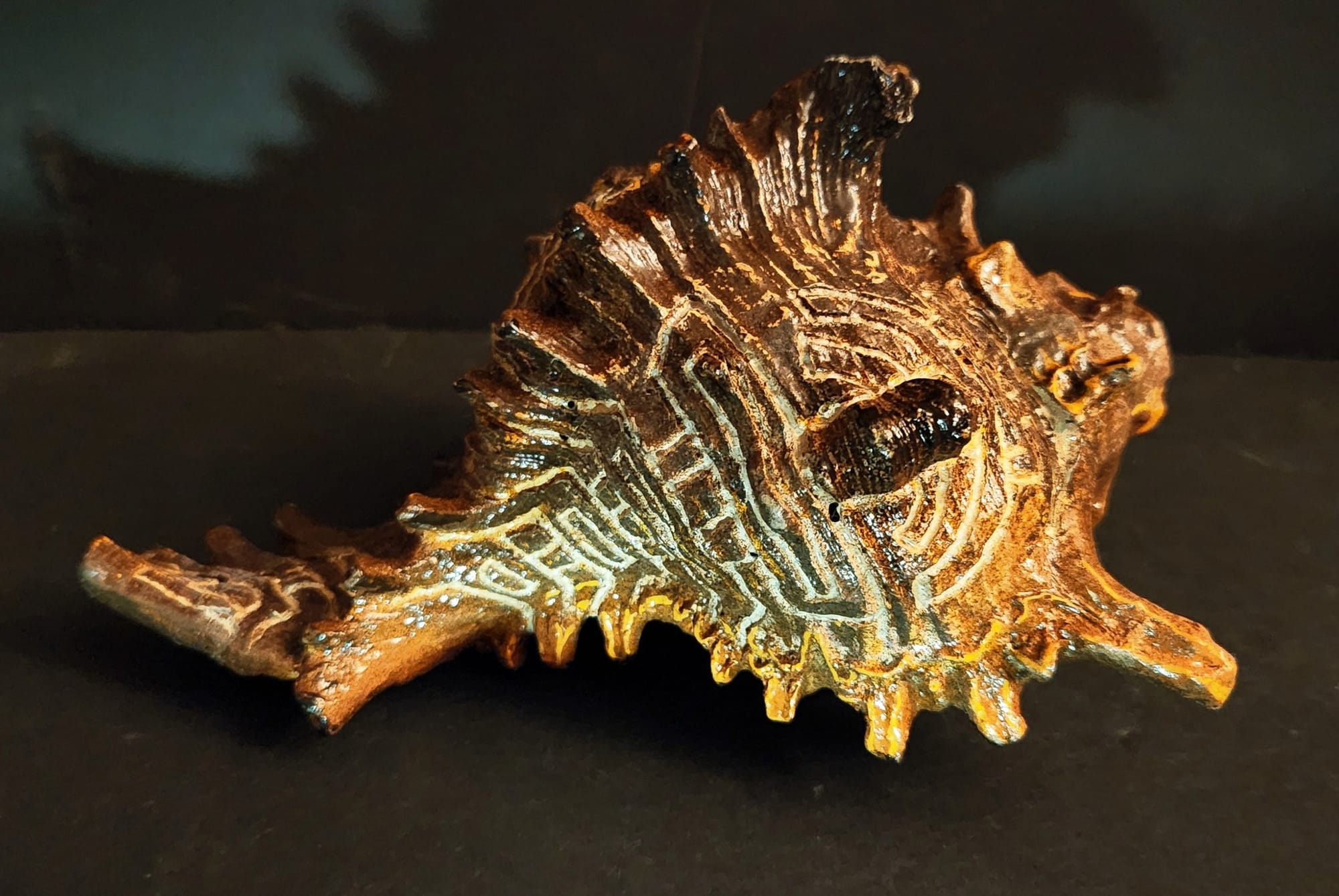
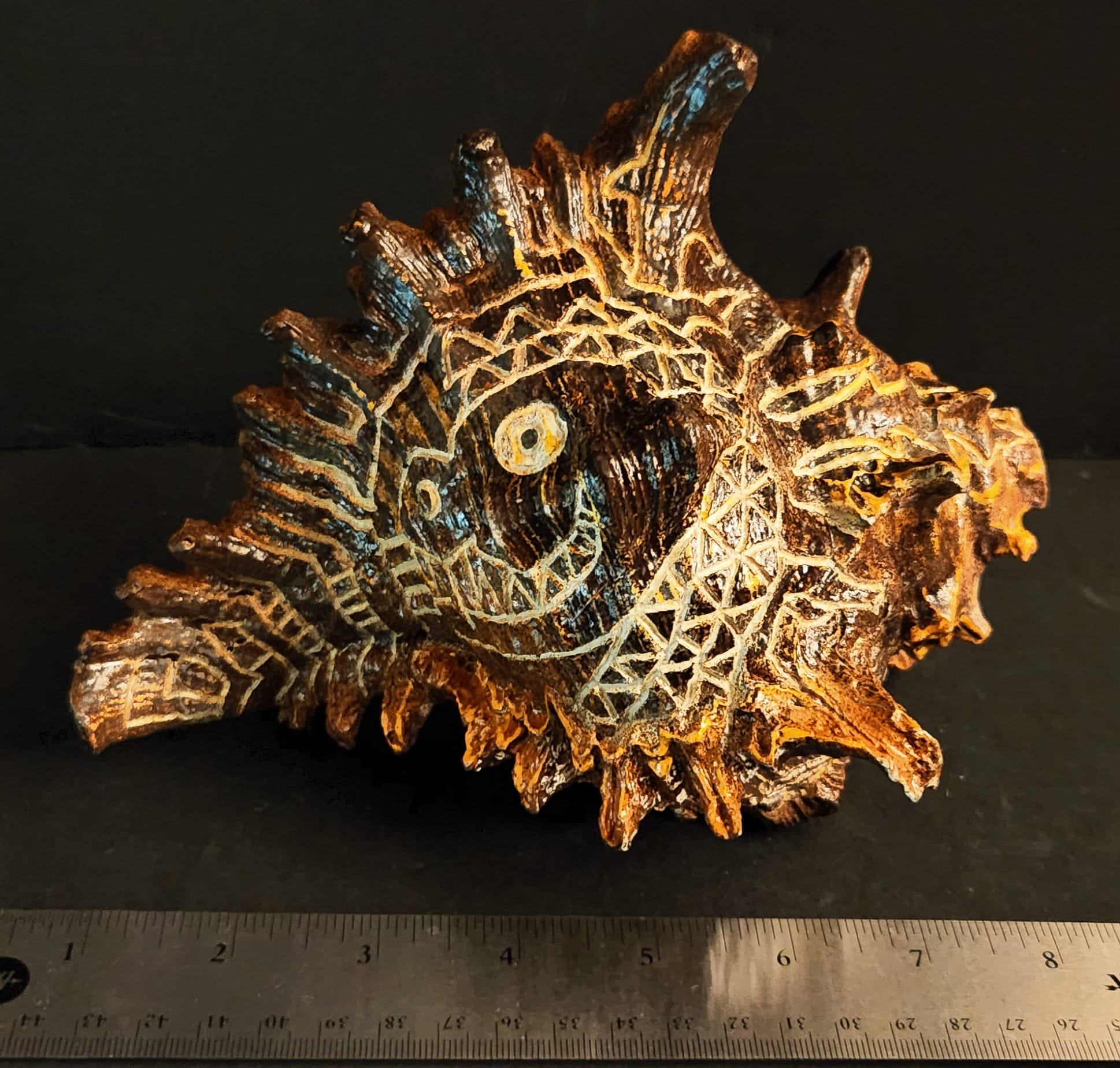
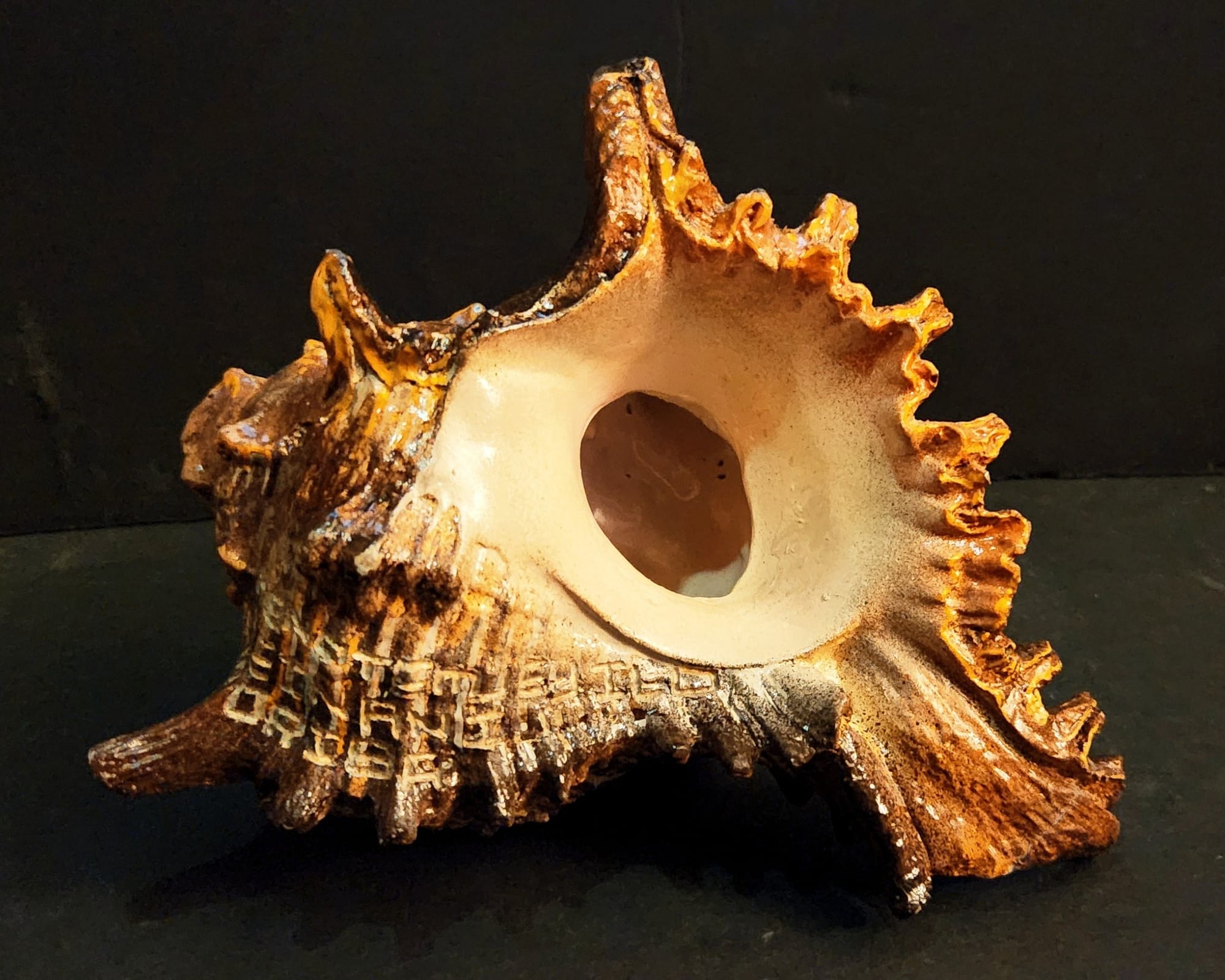
Marshallese Ceremonial Shell Trumpet, circa 00326 A.F.. Photographed by Josh Ballze.
Ceremonial Data: This shell trumpet was one of the first to be created after the Bikini Atoll islands were repatriated back to the Bikinian Marshallese Peoples in 00322 A.F., decades after the island and surrounding waters were irradiated due to nuclear tests. This artifact was meant to commemorate the historical return of the Bikini Atoll Indigenous Peoples to their home after being forced away and relocated by the United States Government in favor of nuclear testing in 01946 A.D.
The Ceremony itself consists of three days of prayer and fasting held on the first of March (the day the first bombs went off in 01954). On the third day, a totem is chosen among the people to be the trumpet bearer and blow the trumpet on all three islands, then one final trumpet sound near the concrete shell covering one of the ground zero detonations. The ceremony varies and is held depending on the status of the environment surrounding the Pacific Ocean and the Pacific Ring of Fire. If the world’s civilizations are in balance with nature and harmony, the Trumpet ceremony is held in remembrance and usually occurs every third year.
However, if the civilizations of the world are judged to be straying from the natural order of the Earth, the Bikinian Peoples will sound the trumpet ahead of the three year cycle. They are represented on the World Nuclear Oversight Committee (WNOC), which meets every year in Hiroshima, Japan and New Mexico, USA to oversee the clean up of radiological disasters all around the globe. Any member of the Committee can call a meeting in response to a “man made” natural disaster or ecological crisis. The Bikinian Peoples' representative will call a crisis meeting and blow the trumpet, kicking off the ceremony on Bikini Atoll where they will then state what ecological or environmental crisis they see was urgent enough to call the Committee into action.
It should be noted that, though the WNOC primarily handles nuclear and radiological disasters, they also work with the world’s ecological conservation programs and groups, and in the case of the disaster being that of an ecological crisis or an endangered species notification, they will defer to the Binikian Peoples (similar to the Vaquita Porpoise crisis of the 02010s).
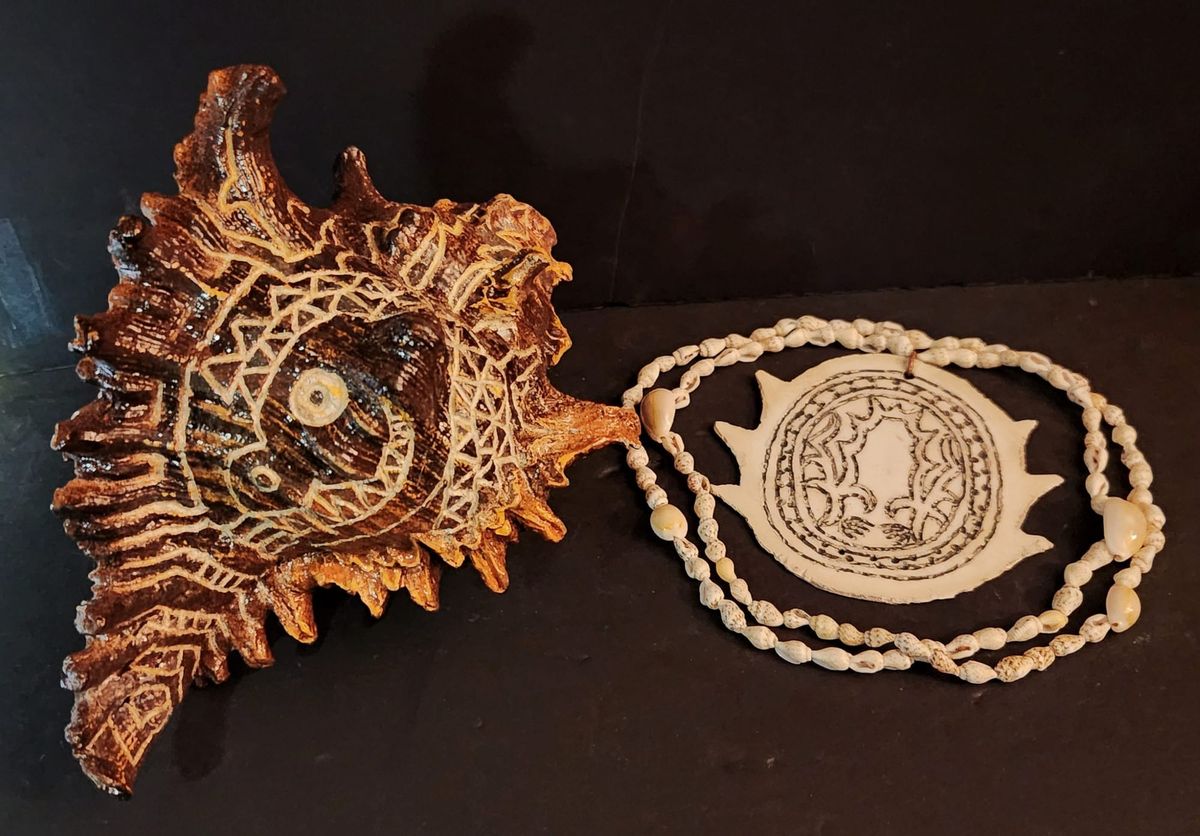
Artifact Description: The Shell Trumpet has various engravings all around the surface, the most prominent being of “Gojira”. The Gojira carving design wraps around the entire face of one side of the shell with intricate patterns of the creature's face, eyes, teeth, dorsal plates and depictions of it breathing fire. Additional designs are found on the opposing side of the dorsal end of the shell.
There are words carved into the ventral side of the shell reading, “MEN OTEMJEJ REJ ILO BEIN ANIJ”. Translated it reads, “Everything is in God’s hands”. This same saying is found on the original Bikinian Flag while they were still displaced around the surrounding islands and in Arkansas USA.
Additional Ceremonial Data and Meanings: The use of Gojira for the shell trumpet is to acknowledge what the monster represented, a milestone where man entered the atomic age and unleashed “monsters” onto the world in the form of radiation poisoning, mutations, and nuclear fallout. When the Binkinian people were displaced after being forcefully removed from their home one of the first islands they were taken to was the isle of Rongerik. The Bikinians did not want to go there as the island was deemed unfit for inhabiting due to an evil spirit known as “Libokra”. The spirit was said to have poisoned the vegetation and the fish, and turned the water brackish.
The adoption of Gojira can be seen as a re-interpretation of the “Libokra” spirit as Gojira was born of radioactive fire which in turn destroyed three of the Bikinian islands in Bikini Atoll. The islands not destroyed were then deemed “poisoned” by the United State Government after the Bikinians petitioned to return to their homes. The “poison” being radiation poisoning and nuclear fallout.
The ceremony itself carries two meanings: the first being that of remembrance, for the peoples of the Pacific Islands and those living on or around the Pacific Ring of Fire to remember the Castle Bravo tests and additional nuclear testing which unleashed the Libroka spirit, Gojira. The ceremony is held to remember those tests and man’s hubris in thinking they could tame the atom. It is meant to force people to remember what was lost, and what can still be lost if humanity is not careful not to heed the lessons of Gojira.
The second meaning is that of a warning. As mentioned the Bikinian and Mashallese people will sound the trumpet in light of a nuclear or ecological disaster. This is to keep mankind on the path of balance with nature and Earth. The shell doesn't ward away the next Gojira or Libroka so to speak, it keeps mankind from becoming the next Gojira, the next nuclear or ecological disaster, the next Gojira.
2: MARSHALLESE CEREMONIAL SHELL GORGET NECKLACE
The Artifact: Marshallese Ceremonial Shell Gorget Necklace
Accession number: KP_02026_002_001B
Date: 00326 A.F. (After Fascism)
Species: Tridacna gigas.bravoi
Species History: Mutated species of Tridacna Giant Clam found thriving in the irradiated waters of Bikini Atoll off the shore of ground zero for the “Castle Bravo” nuclear tests.
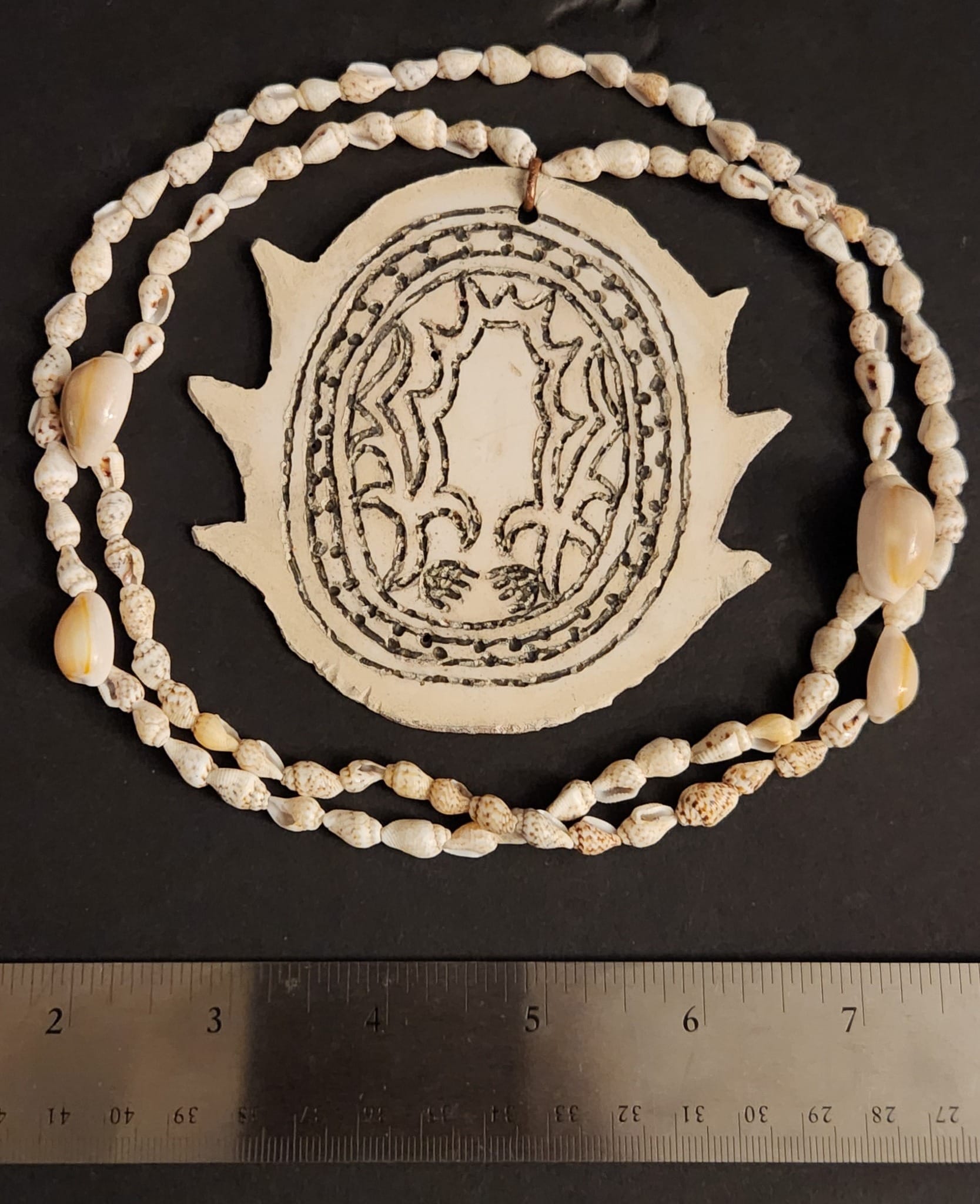
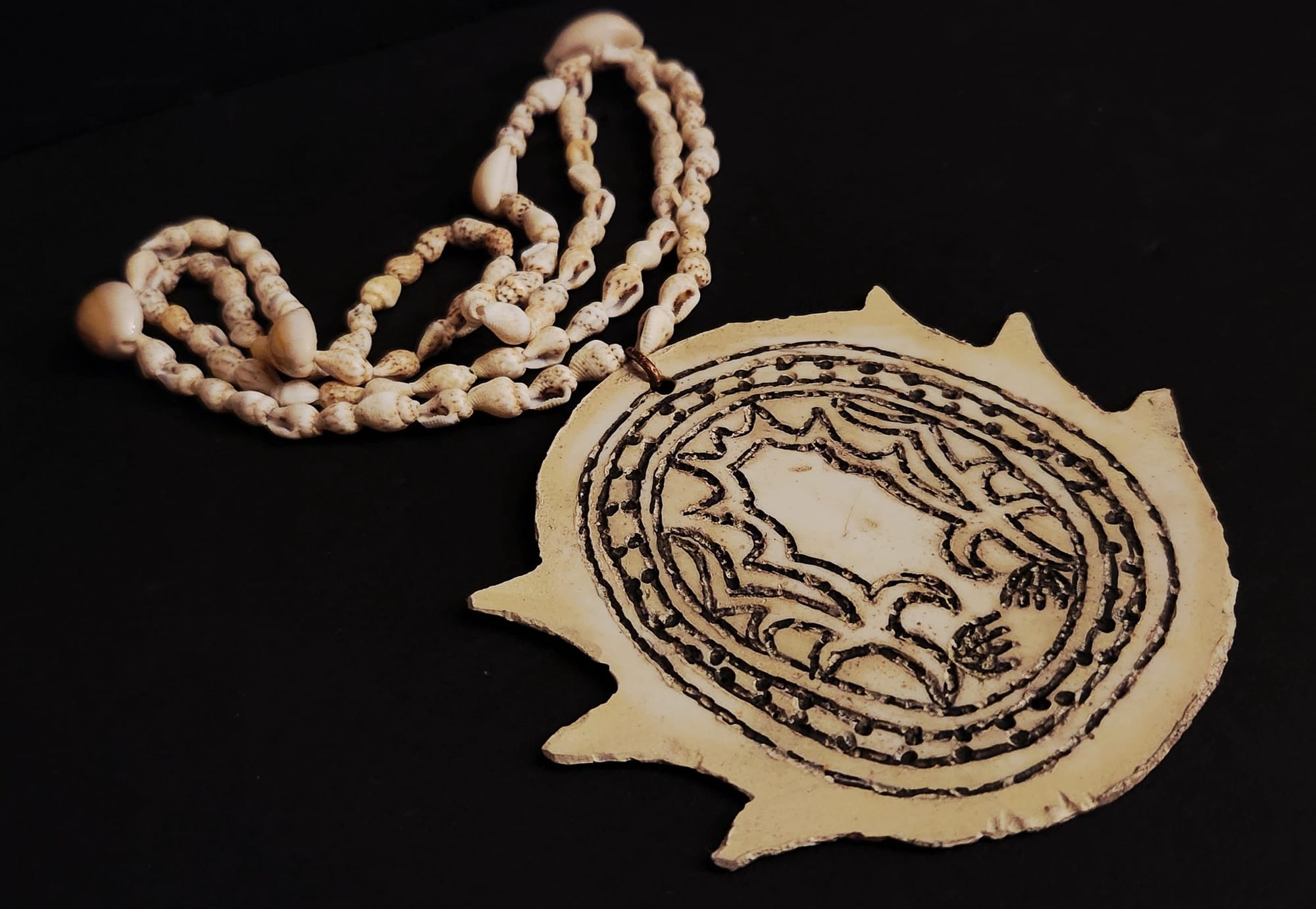
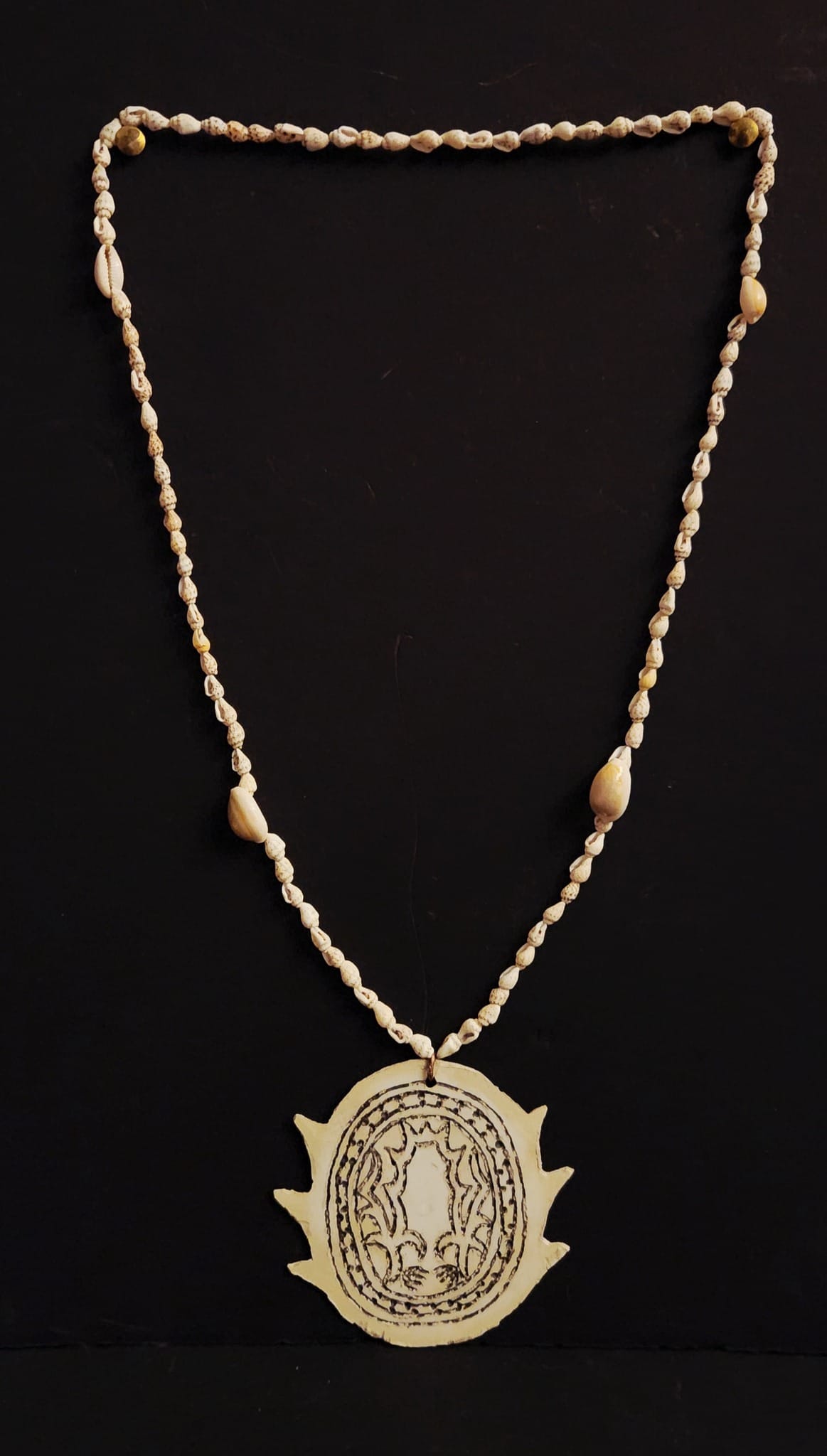
Marshallese Ceremonial Shell Gorget Necklace, circa 00326 A.F.. Photographed by Josh Ballze.
Ceremonial Data: This artifact is a complimentary piece to the Gojira Shell trumpet. It is used in the Shell Trumpet ceremony and is awarded to the “Totem” chosen by the Marshallese and Bikinian peoples for the ceremony. The necklace is meant to absorb the negative spirit energy that comes from summoning Gojira through the trumpet for remembrance. It is also meant to guard the Totem’s soul as noted by the design on the gorget. The totem is a conduit through which the Gojira spirit moves and is summoned. The necklace is given beforehand to endow it with prayers and protection by the Marshallese and Bikinian peoples. These in turn are stored into the necklace so it is “charged” with positive spirit energy before the trumpet is sounded to offset any negative energy the Totem might experience as a conduit for the “summoning”.
Once a ceremony is complete, the necklace is placed with the trumpet in a holding box and set out facing the ocean. There it is “cleansed” through prayers and additional ceremonies facing away from the direction of the castle bravo test sites. It is said the sound of the ocean and nature assists in cleansing it till the next time the ceremony begins anew. The Totem is then sent off to Arkansas in the mainland to assist the remaining Bikinian people there to reconnect with their ceremonies and Indigenous identity. They are also charged with completing an act of conservation be it legislation for more national parks, wildlife protections, or assisting in the saving of endangered species. This act is the final act in cleansing the Totem of any additional burden they carry from blowing the trumpet.
Artifact Description: The shell gorget is carved with intricate patterns indicative of Ulute pendants from the Solomon islands. The inclusion of the Solomon Island community with that of the Marshallese can be seen as a key milestone in the Unification of the Pacific Islander Nations with the shell trumpet ceremony acting as a catalyst. The engravings include circular and knotted patterns carved into the shell surface encircling a dorsal plate design unique to the Gojira spirit. The overall pendant shape itself also mimics this dorsal plate design with a series of spurs jutting out of the sides. The pendant is carved only on one side and is attached to a necklace made of additional sea shells.
Additional Ceremonial Data and Meanings: The reasoning behind the designs can be traced back to the physiology of Gojira. The monster stores radiation and nuclear energy in its dorsal fins which it charges before releasing an atomic blast. This “charging” is why the design was chosen for the pendant as it acts as a “storage” to absorb both good and malevolent spiritual energy. This energy is then released in blowing the trumpet, signifying the release of an “atomic blast”, but in this case it is regarded as “Spirit Energy”.
(Static)
A FAMILIAR MONOTONE VOICE BREAKS THROUGH THE STATIC: "We are now embarking back to the present and past year of 02026. Please keep all limbs inside the vehicle during transport."
(A series of whooshing and whirring sounds, then: silence)
THE SAME VOICE, THIS TIME, GENTLE AND WARM: "Welcome back to the year 02026. We hope you enjoyed your travel. Thank you again for choosing the Kaiju Papers as your Time Travel partner. Be sure to drink plenty of water and allow your body time to reacclimate to the present."
Once again, we encourage you to ask yourself the following questions:
- What conditions led to this future? What made this future possible?
- What actions did I or my people take to contribute to (or hinder) this future?
- What else is possible in this future? How might my descendents be spending their time?
- What actions can I take now, in the present, to make this future more likely?
A NOTE FROM THE ARTIST:
These artifacts were inspired in part by a 2020 exhibit at the Los Angeles Natural History Museum called Godzilla, A Living Atomic Bomb.
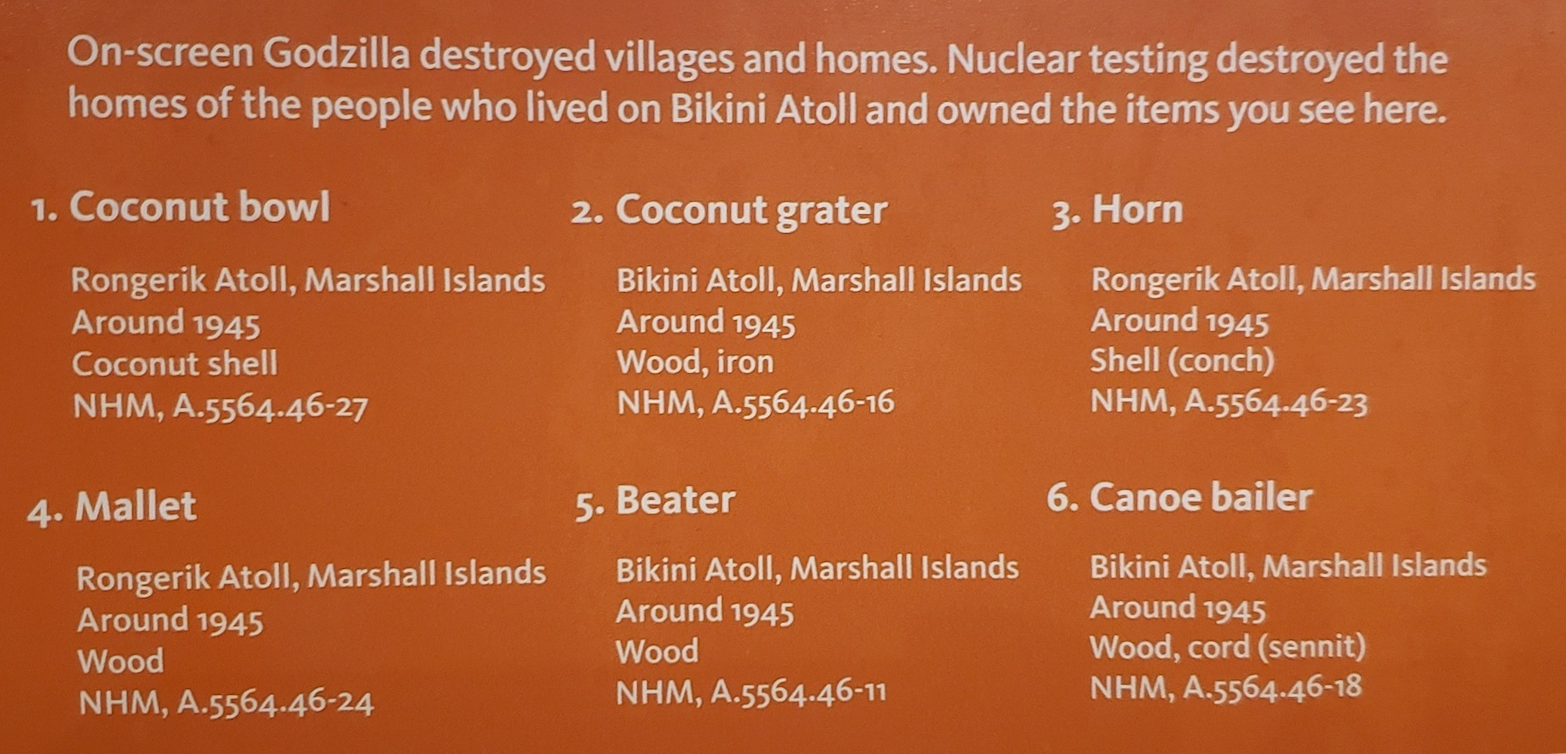
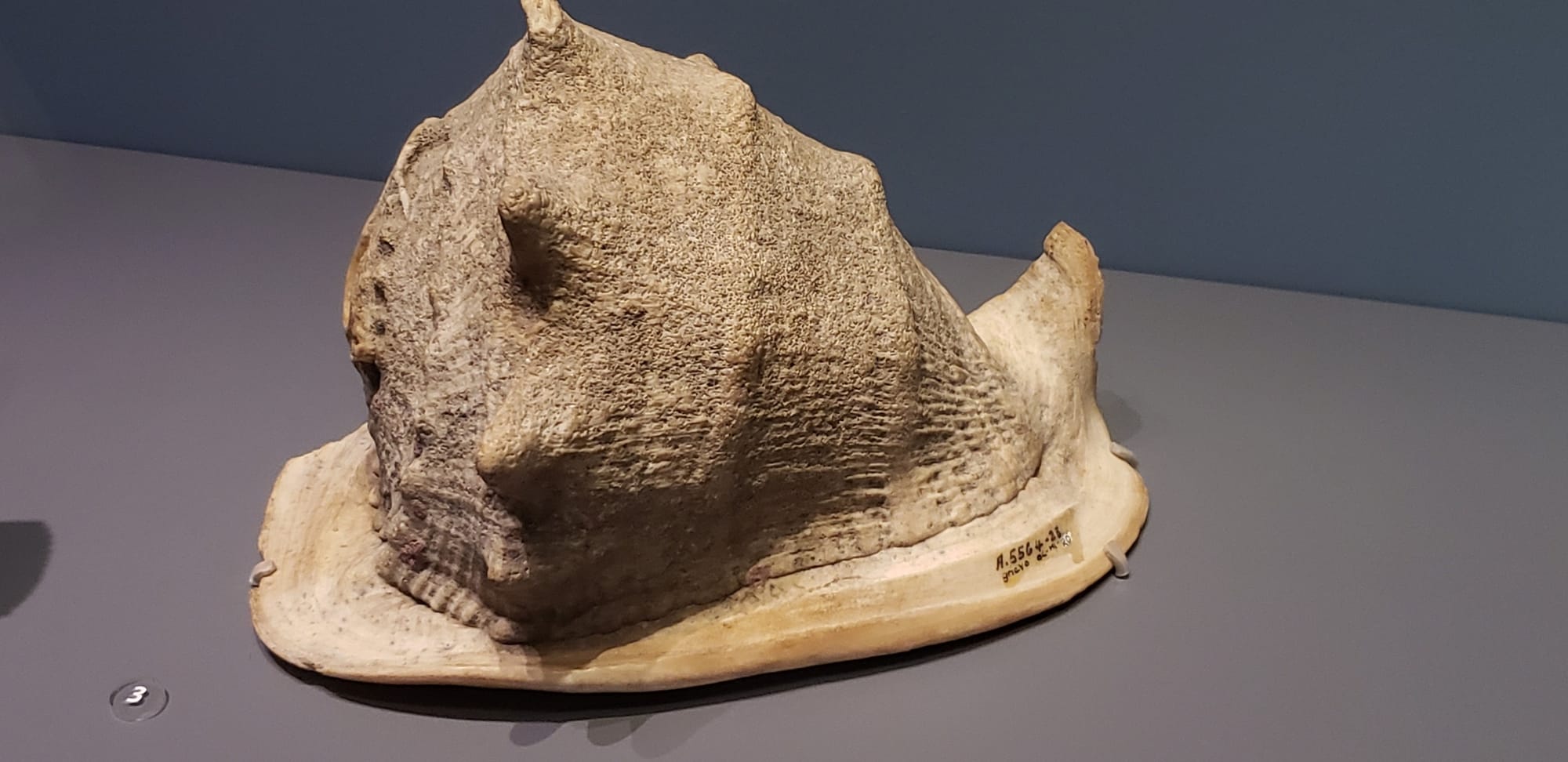
Photos of the exhibit and LANHM taken by Josh Ballze in 2020.
ABOUT JOSH BALLZE:
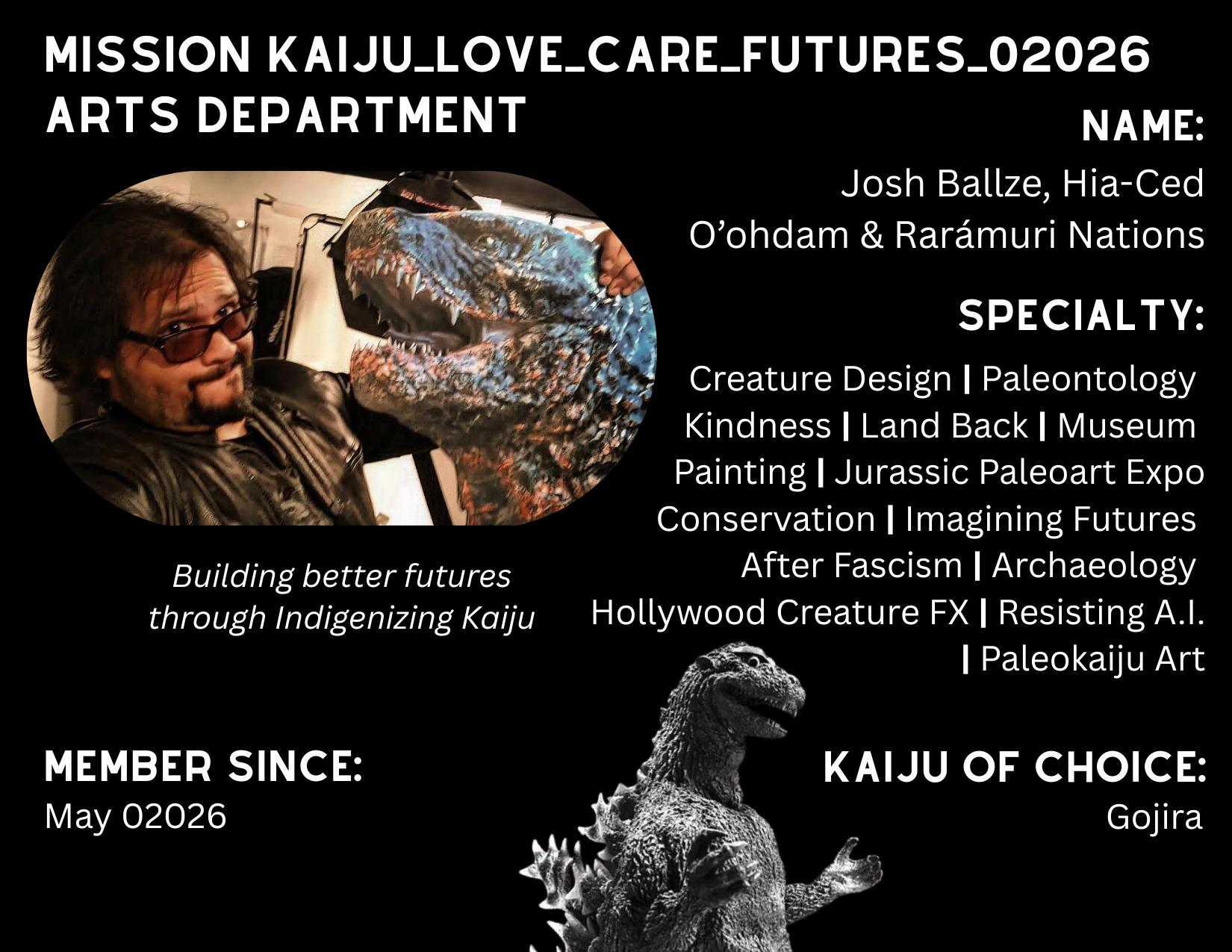
Who are you?
I’m an Indigenous artist from many disciplines including Hollywood Creature FX and Museum Painting for Notable scientific institutions. My museum work can be found all over but the most notable are: Montezuma Castle National Park, Musselshell Historical Museum, Monmouth Museum, and Ogden’s GCE Dinosaur Park. For my work in Hollywood be sure to check out my IMDB.
I’m what’s known as a Mix Blood City Native being born in Southern California (Montebello). My nation affiliations are Hia-Ced O’ohdam and Rarámuri from the Southwest.
Since I was a young kid I was always fascinated with Archaeology and all things Prehistoric (Paleontology), so naturally that comes with a love of a certain radioactive giant mutated dinosaur (Gojirasaurus). I would even be fortunate enough to work with the Godzilla Monsterverse license while employed at Jakks Pacific so being a part of this project (The Kaiju Papers) just seemed like a natural fit. I’m happy to be a part of such a novel project and experience.
What has been your experience working on Mission Kaiju_Love_Care_Futures_02026?
Very gratifying to be honest. It asked me a question that I believe most people need to ask themselves, what is your perfect Utopia. And I sat there trying to figure out what my Utopia would be. When I finally figured it out after some soul searching the rest just seemed to fall effortlessly into place. The more fun part for me was being able to “Indigenize” the genre of ‘Japanese Kaiju’ and working in themes like ceremony, being a part of the land, and Land Back. This project helped give a voice to these themes and I hope through our art mediums, the public will be ready to hear those lessons and take them to heart to strive for that Utopia.
WHERE TO FIND JOSH
Josh's art: Instagram | Website | Facebook | IMBD
Jurassic Paleoart Expo: Instagram | Facebook
LEARN MORE ABOUT THE HISTORY OF THE BIKINIAN PEOPLE
Explore The Bikini Project, maintained by the daughter of one of the architects of the atomic testing that obliterated the islands. This is an example of facing harm done by past generations and choosing to heal.
Read a letter to the U.S. House of Representatives from Anderson Jibas, Mayor of the Kili-Bikini-Ejit Local Government and Peterson Jibas, Vice-Speaker of Nitijela, Parliament of the Marshall Islands and Senator for the Bikinian People that implores Congress to fund the Nuclear Claims Tribunal Award (that was awarded on paper but not fully funded, to our knowledge) that would support the Bikinians' return to their land for the first time since removal.
WHAT’S NEXT?
From the Mission’s Research Methodology:
Co-Creating New Possibilities: The Field Office and Mission HQ will partner to host in-person and virtual Community Sensemaking sessions. These sessions will center around community Backcasting exercises.
We are planning on facilitating six sensemaking sessions (five for each era of Godzilla films, one for the entire franchise) between Summer 02026 and Fall 02027 to answer the question: “what will it take to achieve a version of these imagined futures?”
The hopeful outcome of these sessions is an understanding of what we can change or adopt now in order to make these futures more likely. Members of the public may register their interest in participating in these sessions here.
WANT TO IMAGINE THE FUTURE(S) WITH US? JOIN THE KAIJU MISSION ARTS DEPARTMENT!
Access the Creative Brief at this link!
If you choose to accept the brief and wish to join the Arts Department, please let us know at thekaijupapers@gmail.com.
Thank you. We love you.
If you are enjoying the mission, please share this work with your friends and encourage them to subscribe to The Kaiju Papers (remind them to verify their email!)
By the way: did you know that the Field Office made zines about How To Go To The Future? Get yours here!