KAIJU FIELD REPORT No. 16
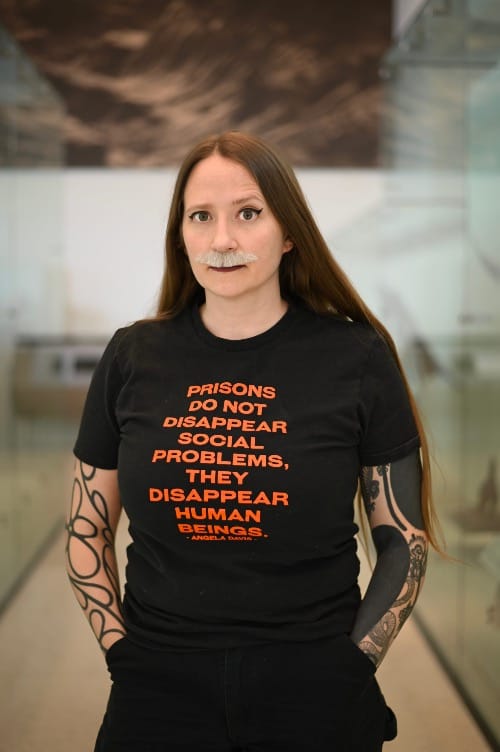
Lessons for humanity from King Kong vs. Godzilla (1962) about the Ainu people, the fact that everything is connected, silence is a political choice, hyperproductivity and capitalism, and how getting on a train in a monster movie is a bad idea.
NEW TO THE MISSION? Access the mission's Research Methodology, About Page, and Site Index.
NOTE FROM MISSION HQ: We are thrilled for the release of the first edition of The Kaiju Papers Literary Magazine on Friday, July 31. This edition will feature four pieces by lovely, monstrous creative writers. Know someone who might like to submit a piece for an upcoming issue? Share this submission form with them!
INCOMING TRANSMISSION / / /
Hello, and apologies for our silence. Egg was in Arkansas on another Kaiju-spotting trip, and when he returned, New York City was blanketed in wildfire smoke and we felt Too Tired to conduct our research. We are human, after all—well, all of us except for Egg and our Chief of Mission Dudley Cramblin. We are back at our desks now, and we hope that Director Stevens won't take disciplinary action.
Thanks to our anonymous Mission Patron, this report explores the lessons for humanity offered in the original Japanese cut of King Kong vs. Godzilla from 1962. We stand by the lessons we outlined after reviewing the 1963 U.S. version (access Field Report No. 6 here), but this time around—on account of the film's use of brownface and other racist tropes—we took the opportunity to learn more about the Ainu people, whose ancestral homelands are in what is now known as Hokkaido in Northern Japan and Sakhalin, Khabarovsk, and Kamchatka in Southeastern Russia.
We would like to remind members of the public that due to our team's lineage, our analysis of the lessons in this film is conducted through an American lens.
That said, we were able to access of a very useful course reader from the Asia-Pacific Journal: Japan Focus, called The Ainu People: Indigeneity, Culture, and Politics, edited by Noboru Tomonari. We encourage members of the public to explore this volume and reference some of the recommended further reading about the Ainu people.
We must also note that while looking for resources mentioning the use of brownface in the film, the most in-depth analysis we could find was:
“The native population of Faro Island is portrayed in the movie by Japanese actors in apparent blackface. Not a stellar moment. Anyway….”
We are of the opinion that this analysis does not go nearly far enough. If members of the public know of other resources and analysis, please contact us.
As you might predict, Julije Morrison, our Political Analyst, took the lead on this one. As he reminds us often: nothing is neutral, and everything is political.
KAIJU FIELD REPORT No. 16
- Date: July 24, 02026
- Location: Brooklyn, NY
- Mission: Kaiju_Love_Care_Futures_02026
- Artifacts Examined:
- King Kong vs Godzilla (1962 - the Original Japanese release)
- Pages 54 - 67: King Kong vs. Godzilla, Chapter One of Part One: Beast of Burden: 1954 to 1975 of Ryfle, S., Godziszewski, E., Carpenter, J., Odaka, M., & Tomiyama, S. (2025). Godzilla: The First 70 Years: The Official Illustrated History of the Japanese Productions. Abrams Books.
- Rations Consumed: three espresso, a protein bar, a cauliflower pizza, one hundred mini cupcakes
- Chief of Mission (AKA Dudley the Dog) Present? Yes
We will look to Ryfle and Godziszewski for a synopsis:
King Kong vs. Godzilla was part of Toho's much-hyped slate of thirtieth anniversary films and the first Godzilla movie in color, Toho Scope (the studio's widescreen format), and with a stereophonic soundtrack. It embraced the comic side of kaiju, with a story that is part monster mash and part manzai, a traditional style of straight man-funny man comedy. Tako (Ichiro Arishima), the manic publicity manager of Pacific Pharmaceuticals, tries to boost the rating of an unpopular TV program his company sponsors by dispatching hot-headed cameraman Sakurai (Tadao Takashima) and his bumbling soundman sidekick, Furue (Yu Fujiki), to tiny Faro Island, located in the Solomon Islands chain, to investigate rumors of a "mammoth evil spirit," which turns out to be the mighty Kong. The men and their goofy interpreter (Senkichi Omura) appease the island natives (Japanese actors in dark makeup), then tow a sedated Kong back to Japan with plans to exploit the creature on TV. Meanwhile, Godzilla, glowing with radioactivity, bursts out of an iceberg in the Arctic, destroys a United Nations submarine, then trashes a military outpost (which appears to be Soviet) and heads south. Godzilla's territorial traits are explained by Shigezawa (Akihiko Hirata), a government scientist, who says Godzilla has a "homing instinct" and will return to Japan without fail." It's a brief but important rationale for much of Godzilla's behavior through the decades. - Page 56, The First 70 Years
Before we offer what we’ve learned, we will point out some classic anti-Indigenous tropes in King Kong vs. Godzilla. These tropes can be found across film and television! We are not asserting that the whole film should be thrown away for that this is the only racist film. We simply cannot move forward responsibly in our Artifact Review without exploring these themes.
- When they arrive on Faro Island, one of our protagonists exclaims, “I hope we don’t get barbequed!” Please see Lesson for Humanity No. 2 in Field Report No. 9, which explores Ebirah, Horror of the Deep (1966): We Must Unlearn our Anti-Indigenous Racism.
- To secure their time on the island, our protagonists give the Indigenous chief a transistor radio. He is portrayed as simple, untouched by the outside world, and primitive—this caricature is deeply rooted in the myth of pseudo-scientific racism and eugenics.
- The many actors in brownface are essentially treated as props—they dance, they carry the Japanese characters’ cargo, and provide comic relief. No character development and very little humanity.
We should also note that the film portrays people Indigenous to a fictional Faro island in the Solomon Islands—an archipelago of approximately 992 small islands that are home to many Indigenous people, including Melanesian, Polynesian, and Micronesian folks. Members of the public can learn more about people Indigenous to this region here.
For the purposes of this Field Report, we are focused primarily on the history of the Ainu people, whose ancestral homelands are in what is now known as Hokkaido in Northern Japan and Sakhalin, Khabarovsk, and Kamchatka in Southeastern Russia. What follow are lessons for humanity about the Ainu people, the fact that everything is connected, silence is a political choice, hyperproductivity and capitalism, and how getting on a train in a monster movie is a bad idea.
LESSON FOR HUMANITY NO. 1: The Ainu People are still here.
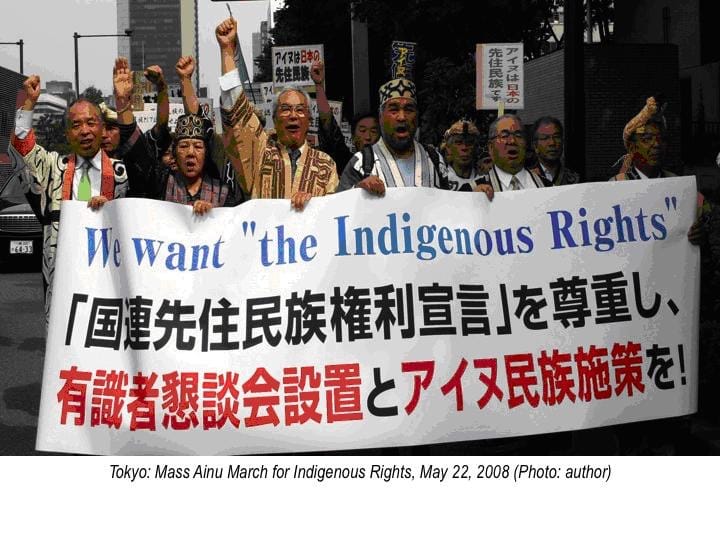
Before we share our learnings about Japan’s colonization of Ezo (now known as Hokkaido) and the Ainu people, we wish to ground this Field Report in the fact that the Ainu, like many Indigenous folks all over the globe, are still here.
In Indigenous At Last! Ainu Grassroots Organizing and the Indigenous Peoples Summit in Ainu Mosir, ann-elise lewallen writes,
On June 6, 2008, Ainu people across Japan achieved a long-sought goal: they were unanimously granted recognition as an indigenous people by both houses of the Diet with passage of the “Resolution calling for the Recognition of the Ainu People as an Indigenous People of Japan.”
Reading ann-elise lewallen’s work led us to the Ainu Rebels, a song and dance troupe that contributed to the revitalization and preservation of Ainu culture. Access a 2009 video that features their work and some interviews here: The Ainu Rebels
The Ainu Rebels
Not unlike many Indigenous communities across Turtle Island (or the so-called United States, Mexico, and Canada), the Ainu fought for recognition for many years.
To learn more, members of the public are encouraged to access the following resources:
WATCH: Documentary sheds light on Ainu | NHK WORLD-JAPAN New
EXPLORE: Virtual National Ainu Museum (or visit in person in Hokkaido!)
One of the myths on which empire is built and reinforced is that Indigenous peoples are a mythical group from a distant past. David Graeber and David Wengrow put it better than we at the Field Office ever could. In The Dawn of Everything, they write:
“Rousseau has been accused of many crimes. He is innocent of most of them. If there is really a toxic element in his legacy, it is this: not his promulgation of the image of the 'noble savage', which he didn't really do, but his promulgation of what we might call the 'myth of the stupid savage' - even if one he considered blissful in its state of stupidity.
Nineteenth-century imperialists adopted the stereotype enthusiastically, merely adding on a variety of ostensibly scientific justifications - from Darwinian evolutionism to 'scientific' racism - to elaborate on that notion of innocent simplicity, and thus provide a pretext for pushing the remaining free peoples of the world (or increasingly, as European imperial expansion continued, the formerly free peoples) into a conceptual space where their judgements no longer seemed threatening. This is the work we are trying to undo.” - Page 73, The Dawn of Everything
The Ainu are not mythical. The racist caricatures in King Kong vs. Godzilla are.
LESSON FOR HUMANITY No. 2: Empire begets empire begets assimilation begets cultural erasure and genocide
In the introduction to The Ainu People: Indigeneity, Culture and Politics, Noboru Tomonari writes:
Ezo, on the outskirts of Japan, was the first place to be annexed and made into Japanese territory after the Meiji restoration of 1868. Because of this, the Ainu are often regarded as the first victims of Japanese colonialism. As such, their plight was similar to that of Native Americans in North America and other indigenous peoples all over the world. Indeed, the new government of Meiji (1868-1912; named to emphasize the Meiji emperor’s reign) further entrenched their subjugation.
The Meiji restoration of 1868 was a seminal event in modern Japanese history in that it marked the moment when the Shogunate and samurai rule collapsed, and the modern, centralized Japanese state with the emperor as a sovereign monarch began. When the Japanese annexed Ezo, they also renamed it Hokkaido. While “Ezo” signified a barbarian land, “Hokkaido” in Japanese means “the north sea road” or “the path to the northern seas.” The Japanese saw control of the island not only as an end in itself but also as their gateway to the seas and lands farther north. The emergence of modern Japan also heralded the beginning of the Japanese empire: Japanese colonial rule over other Asians and their lands. The late 19th century was an era of imperial rivalries, and Japan competed with the Russian empire for hegemony over the area to their north. Farther south, the Japanese competed with the Americans, British, French, Dutch, and Germans, among others. China, which had dominated East and Southeast Asia in earlier periods, was eclipsed and divided at this time by the European imperial nations. The Europeans colonized small portions of China, such as Hong Kong, and crippled the government’s control over the rest of the country. Many Japanese were resolute that they would not go China’s way.
While we are not, by any stretch of the imagination, experts in Japanese history, we at the Field Office are struck by a pattern we see recurring through recent oppressive and fascistic regimes: U.S. influence. In Rule in the Name of Protection: The Japanese State, the Ainu, and the Vocabulary of Colonialism, Komori Yoichi writes:
[in the 1870s] The Hokkaido Development Agency carried out blatant assimilation policies, issuing most notably an order that strictly abolished “customs” that were deeply rooted in Ainu livelihood.
Announcement to Natives [from the Hokkaido Development Agency]:
1. Those people who engage in opening land will be provided with a house, farming implements, and other things, and it is forbidden to burn the house of a deceased person and change residences, as has been hitherto the custom.
2. It is strictly forbidden for girls born hereafter to be tattooed.
3. Hereafter, the custom of wearing earrings is strictly forbidden for men, but for the time being, women may do as they wish.
4. One must make every effort to learn spoken Japanese, of course, but also the rules of written Japanese.
In the first place, in the phrasing “people who engage in opening land” there lies a notion that denies the fundamentals of Ainu life. Only people who open land and undertake farming are recognized. However, Ainu livelihood relied primarily on hunting and fishing, not to mention the fact that they did not have the concept of owning land or private ownership. According to the Ainu, Ainu Moshir, or the Quiet Land of Humans, was a collectively shared natural world. Still, the Hokkaido Development Agency passed the Land Holdings Regulation in September of 1872, and land that had already been “opened and planted” was converted into privately owned land, while, with the exception of areas that had previously been designated for government use or private “lease land,” all of Hokkaido, as a government-owned entity, was put up for sale to interested private parties. This regulation was for the sake of none other than “mainlanders.” Vast areas where Ainu were once able to hunt and fish were expropriated as land for Japanese settlers. In a similar fashion, the rituals related to Ainu traditional views on life and death were denied, and Ainu were even forced to adopt the gendered customs of the so-called mainlanders. It goes without saying that the language of the Hokkaido Development Agency’s announcement is Japanese. The Ainu language, which did not have a writing system, was not acknowledged as a language. Thus, Hokkaido became a place where only mainlanders could live and prosper, and “cooperating with natives” there was fundamentally impossible.
This was not, however, solely the idea of the Hokkaido Development Agency’s director Kuroda Kiyotaka. Kuroda, who had traveled to the United States, invited Horace Capron, commissioner of the Department of Agriculture under the authority of the victorious Civil War general President Grant, as a foreign consultant to assist in “developing Hokkaido.” The offer to Capron set his yearly salary at 10,000 dollars and included housing. Capron, after arriving in Japan in 1871, ordered a survey by forestry agents and chemists who had accompanied him from the United States, instructing them to search for appropriate farming, logging, and mining locations. America’s putative development path after the opening of the transcontinental railroad was put into practice in Hokkaido. That is to say, the strategic aggression against, and encroachment upon, American indigenous peoples by Anglo-Saxon “immigrants” were replicated by Japanese immigrants in Hokkaido, the homeland of the Ainu.
We can find U.S. influence in other regimes’ violence against Indigenous and other marginalized peoples: both Nazi Germany and the architects and enforcers of South African apartheid took inspiration and assistance from American scientists and eugenicists.
As Harriet Washington writes in Medical Apartheid: The Dark History of Medical Experimentation on Black Americans from Colonial Time to the Present:
Predictably warm relations reigned between American eugenicists and the Germans … Laughlin [head of the Station for Experiment Evolution and Deputy to Charles Davenport at the Eugenics Record Office] shared detailed information about eugenic sterilization in the United States with Eugene Fischer, director of Berlin’s Institute for Anthropology, Human Genetics and Eugenics. In gratitude, Heidelberg University awarded Laughlin an honorary doctor of medicine degree in 1936.” - Page 194
For members of the public who may not be aware: the U.S. has a long and storied history of forced sterilization of Indigenous, Black, Puerto Rican, disabled, incarcerated, and poor folks.
Regarding U.S. influence on South African apartheid, Washington writes:
The South African bioterrorist campaign depended upon very close relationships with U.S. scientists. Despite the supposed isolation imposed upon South African scientists by the international embargoes of the 1980s and 1990s, Basson and his minions could not have undertaken biological warfare without the support of the U.S. government. From 1981 until 1993 the United States supported Wouter Bassoon's weaponization programs by financing close collaborations with U.S. scientists and by sponsoring Basson's sojourns to the United States for conferences and education. For example, in 1983, Basson attended a closed Department of Defense conference on biological and chemical warfare in San Antonio," During his trial, Basson recounted his participation in a 1981 federal conference in San Antonio with army officers from the United States, West Germany, Japan, Britain, and Canada. He declared, "I must confirm that the structure of the [Chemical and Biological Warfare Programme - CWBP] project was based on the U.S. system. That's where we learnt the most."
Basson says he was also grateful for expert American consultants, because the CBWP was dependent upon a colorful assortment of American scientists, especially Larry Ford, M.D., of California.” - page 373
NOTE FROM JULIJE: for a Marxist analysis of Japanese colonization of the Ainu, read Katsuya Hirano’s essay, The Politics of Colonial Translation: On the Narrative of the Ainu as a ‘Vanishing Ethnicity’.
Everything is connected. Nothing occurs in a vacuum.
LESSON FOR HUMANITY No. 3: Silences in the archive serve empire and perpetuate violence
As you have heard us complain, it was very difficult to access the Japanese cut of King Kong vs. Godzilla (1962) due to copyright issues, capitalism, and a lack of funds. While we are grateful to our anonymous Mission Patron for granting us access to the film, we feel compelled to point out that this control of information and knowledge is indicative of a larger pattern.
In Translating Blackness: Latinx Colonialities in Global Perspective, Lorgia García Peña writes,
Michel Foucault writes that archives are the "law of what can be said." They are what organize hierarchies of time and statements of truth and are also locations of power that grant historians credibility. For historians, the archive is the place of legitimacy where their “truth” is sanctioned. But as many scholars of critical archival studies have noted, traditional archives, heritage institutions, and historical publications are filled with silences regarding the lives, agency, participation, and cultural production of Black people. The process of silencing, as Trulliot reminds us, begins at the source of creation, not at the archive. - Page 92
So, too, are the archives filled with silences about the lives, agency, participation, and cultural participation of the Ainu and other Indigenous people. While we are nowhere near finished exploring the whole of the Kaiju archives, we have found that the Kaiju and Godzilla archives we have explored so far are full of silences regarding the use of brownface and other racist tropes.
What might our shared futures look and feel like if there were no more silences in the archive(s)? A question the Arts Department might be able to answer.
LESSON FOR HUMANITY NO. 4: Pharma profits from manufactured urgency and hyperproductivity
In the film, Pacific Pharmaceuticals is looking to boost sales of their signature drug, Pashin. Pashin is marketed as the fountain of youth, from which people can gain enthusiasm, stamina, and energy! It’s exciting! Buy! Buy! Buy!
Most advertisements, even today, are for products that promise to make us more productive, more able, more youthful, more skinny … more able to feed the machines of profit! Buy! Buy! Buy!
We don’t have much else to say here, except to ask: what might our shared futures look and feel like if we didn’t have to produce to live? If we didn’t have to bend our bodies and minds into a shape that creates profits and optimization? Another question for the Arts Department.
LESSON FOR HUMANITY NO. 5: Getting on a train in a monster movie is a still a bad idea
Forgive us, but we believe this lesson, originally published in Field Report No. 6, bears repeating:
Each time we see a movie monster and a train, it ends badly for both the train and the passengers.
If one finds oneself in the vicinity of Godzilla, Kong, or other Very Big Guys, we suggest that getting on a train is not the safest option.
We thank you again for your patience, and thank our Mission Patron for granting us access to this film. If members of the public have any complaints, they may contact Egg.
Rations are well-stocked, thought we've developed somewhat of a miniature cupcake problem. We look forward to submitting our Field Report exploring Godzilla vs. Gigan (1972) in early August.
The Kaiju Papers Field Office Team
/ / / END OF TRANSMISSION
Thank you for supporting independent, rigorous (and also fake) research. If you would like to support the mission futher, keep in mind that paid subscribers get a seat on the Mission Board of Directors and receive Kaiju-themed postcards with behind-the-scenes mission updates, dispatched monthly. Thank you, we love you, goodbye.