KAIJU FIELD REPORT No. 14
Five lessons from Godzilla vs. Hedorah (1971) about the importance of Landback, choosing differently, resisting false solutions, the fact that we are a part of nature, and the assertion that capitalism is not reformable and must be dismantled piece by piece.
New to the Mission? Start Here or access TKP's Site Index!
From Mission HQ: Ahead of the Field Office’s 14th Field Report, we have a few updates to share:
- Today is the final day to provide input into the strategic planning process for Mission Kaiju_Love_Care_Futures_02026 via this survey.
- We now have an FAQ page for those wondering "what is The Kaiju Papers? or "why is The Kaiju Papers?"
- Speaking of "why is The Kaiju Papers?"—TKP's creator just published a piece about the first four months of the project and what's next.
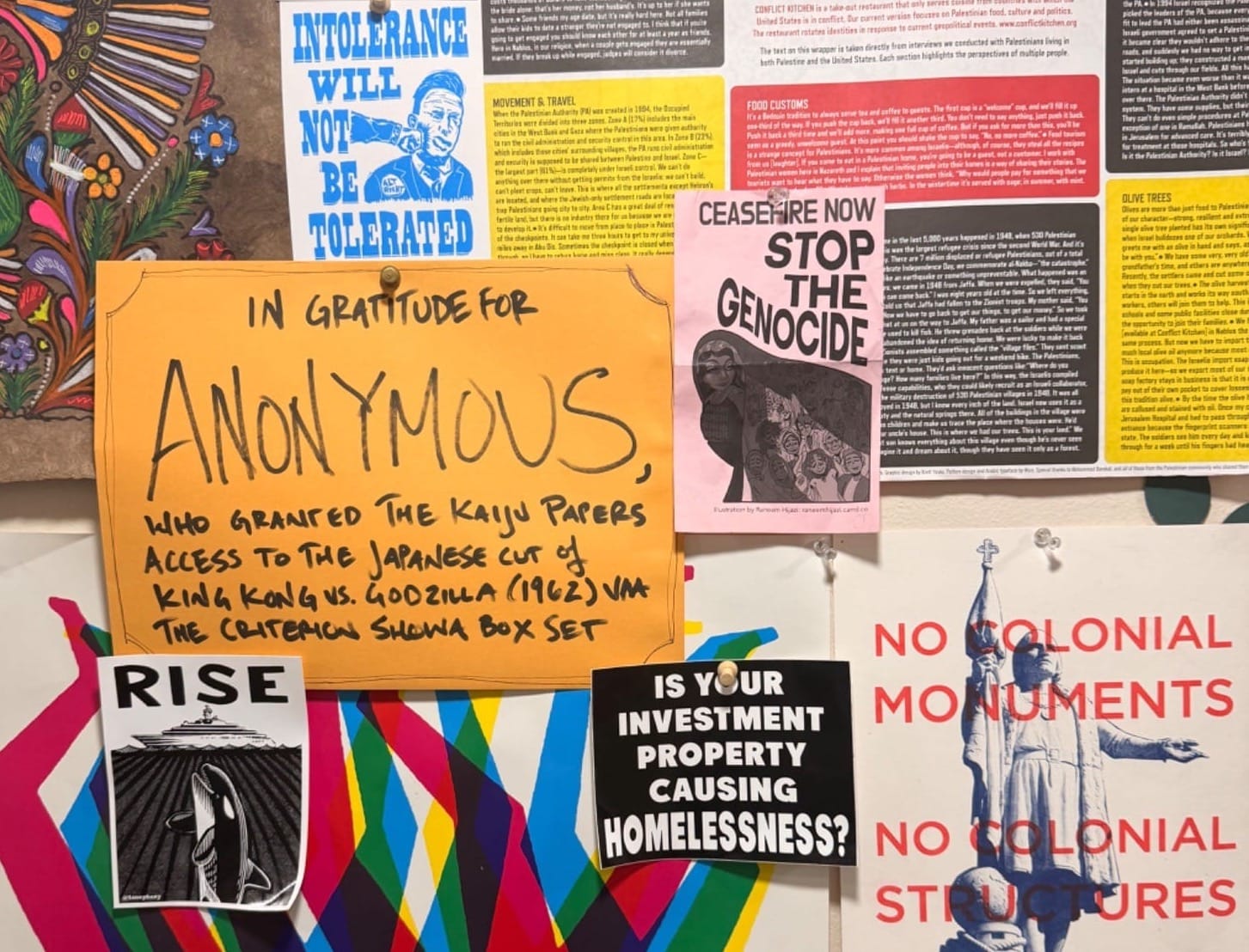
- We are also pleased to announce that the Field Office has finally gained access to the Japanese cut of King Kong vs. Godzilla (1962) via the Criterion Collection’s Showa Era Box Set, thanks to a Mission Patron who is an experienced time traveller. See the team’s announcement here! A Field Report exploring the lessons for humanity in the 1962 version is forthcoming. This Mission Patron, who wishes to remain anonymous, has a plaque dedicated to them hanging in the Field Office. In compliance with our protocols, this plaque will hang in the Field Office in perpetuity or until NYC is underwater.
CONTENT WARNING: Like the film it explores, the following Field Report might be considered heavy-handed. Its writing was spearheaded by the Field Office’s Political Analyst, Julije Morrison. (Some of you may remember his work on Field Report No. 7).
Fear not, and please don’t go! Next week we will lighten the mood with an illustration of a future in which humanity operates from a place of patience, collective care, and in which we honor grief as a form of love. This dispatch from the future, to be disseminated next Friday, July 3, was crafted by Arts Department veteran Kari (Marigold) Cadenhead. Learn more about her and her work here.
INCOMING TRANSMISSION / / /
Hello.
We were told this movie is Very Weird. We found it to be normal.
That said, many of us here at the Field Office were raised on the documentary series Monty Python’s Flying Circus, Kurt Vonnegut books, and other media from the 1960s and 1970s. And, we know this might surprise you, but Dr. Tex has ingested his fair share of mind-altering substances. That said, we know that “weird” is relative. A good reminder that we all have different thresholds and starting points!
During our artifact review, we read about Hedorah Director Yoshimitsu Banno’s reflection on working on the film and immediately felt that Banno might be a kindred spirit to us here at the Field Office:
“"It was maybe too early," Banno said of his film. "People weren't ready for it. The reason I never got to do another Godzilla movie was because I did too much of everything. It was like I turned over a toy box, I think. They may have worried what I would come up with next."” - Page 162, The First 70 Years, Ryfle & Godziszewski
While we are aware that those of you at Mission HQ (especially Deputy Director Vera Rowen) are often worried about 'what we will come up with next', we are encouraged by the overall shift in attitude towards our work and hope to continue bringing you along.
Before we dive in, we must warn that this Field Report is not one that will make members of the public feel as though everything is "fine." We encourage folks to remember that we must examine our collective wounds in order to treat them effectively, and to consider taking some deep breaths and going outside after reading this Field Report.
Perhaps members of the public can get themselves a little treat today.
KAIJU FIELD REPORT No. 14
- Date: June 26, 02026
- Location: Brooklyn, NY
- Mission: Kaiju_Love_Care_Futures_02026
- Artifacts Examined:
- Godzilla vs. Hedorah (1971)
- Pages 154 -163: Godzilla vs. Hedorah, Chapter One of Part One: Beast of Burden: 1954 to 1975 of Ryfle, S., Godziszewski, E., Carpenter, J., Odaka, M., & Tomiyama, S. (2025). Godzilla: The First 70 Years: The Official Illustrated History of the Japanese Productions. Abrams Books.
- Rations Consumed: several mini wontons, a bunch of espresso, greek yogurt with berries and granola
- Chief of Mission (AKA Dudley the Dog) Present? Yes
- Soundtrack: Everything ever recorded by the band IDLES
Be advised: Godzilla vs. Hedorah is not a work of fiction. The film is a story of what can happen when industrial profits are prioritized over the health of people and the planet. Throughout, we see familiar sights: floating garbage, water that catches on fire after making contact with Godzilla's radioactive breath, many species lost, people choking on polluted air … these scenes bring to mind the Great Pacific Garbage Patch (the biggest of several marine trash vortexes), various rivers that have caught on fire due to oil and chemical spillage, rapid biodiversity loss in all species, and air pollution-related illness and deaths across the globe. Ouch.
Ryfle and Godziszewski provide some background about Godzilla vs. Hedorah’s director, Yoshimitsu Banno, and what was going on in Japan at the time:
“Banno had grown up near the sea and was ecology-minded. He admired biologist Rachel Carson, whose 1962 bestseller, Silent Spring, helped inspire the environmental movement; Banno's lyrics for the film's theme song, "Give Back the Sun," would be inspired by Carson's writing. However, Hedorah is more specifically a response to the plague of pollution-related illnesses that struck Japan in the 1950s and '60s.
These included Minamata disease, caused by mercury poisoning of coastal fisheries; Yokkaichi Asthma, resulting from factory emissions of sulfur dioxide; and itai-itai (ouch-ouch) disease, linked to cadmium dumped in rivers by mining companies. The film would mirror the victims' suffering and the public outcry that followed: beautiful Mount Fuji watching over smoke-belching factories; trash and scum floating on waterways ("Banno was so into it, he even brought rotten fish to the studio-it was so stinky!" recalled Nakano); a crying baby covered in mud; political protests; irate citizens; oxygen masks for sale; a young boy washing pollutants from his eyes; reports of mass casualties. - Page 156, The First 70 Years
In this Field Report, we offer five lessons about the importance of Landback, choosing differently, resisting false solutions, the fact that we are a part of nature, and the assertion that capitalism is not reformable and must be dismantled piece by piece.
LESSON FOR HUMANITY NO. 1: Give It Back! (Landback!)
Godzilla vs. Hedorah opens with the song Give Back The Sun, performed by Mari Keiko, Honey Knights, and Moon Drops, with lyrics by Yoshimitsu Banno and music composed by Riichiro Manabe. As images of garbage and sludge-filled water splashes across the screen, we see the translated lyrics:
Islands... fish... where've you gone? / Dragonflies... butterflies... where've you gone? /Mercury, cobalt, cadmium / Lead, sulfuric-acid, oxidants / Cyanogen, manganese, vanadium / Chromium, potassium, strontium
Filthy polluted oceans, filthy polluted air / Living things will no longer exist / Fields... mountains… / Become silent /On the Earth there is nobody / Nobody around who can cry / Give it back!
While we acknowledge that we cannot speak to Banno’s original intent with these lyrics, we immediately thought of the movement for Landback, which we believe is the correct course of action as we build more just and equitable futures. From the Landback Action Network:
“Landback is an Indigenous-led, spiritually grounded, organizing, and narrative framework from which we work toward collective liberation. It is the way we reclaim our right to restore, uphold, and protect our symbiotic and just relationships with Mother Earth, all forms of life, and each other. It is about achieving embodied sovereignty that heals the destruction of generations of colonial violence against Mother Earth, women, two spirit relatives, and all peoples who have been exploited and systemically oppressed by unsustainable systems rooted in violent supremacist ideologies. Everything connects to Landback – from returning stolen lands to reclaiming everything that has been taken by colonization.
Landback is about exercising sovereignty and self-determination to become the people who the land wants and needs.” - Landback Action Network
Roxanne Dunbar-Ortiz speaks to an example of “everything that has been taken by colonization:”
Another important form of reparations is the repatriation of remains of dead ancestors and burial items. After considerable struggle on the part of Indigenous religious practitioners, Congress enacted the Native American Graves Protection and Repatriation Act of 1990 (NAGPRA), which requires that museums return human remains and burial items to the appropriate Indigenous communities. - Page 207, An Indigenous Peoples' History of the United States
We posit that Banno’s lyrics can be understood as a call for Landback and Indigenous leadership in the movement for climate justice, which is a key in every other struggle for justice and collective liberation.
What might our shared futures look and feel like if land were returned to Indigenous stewardship across the globe? A member of the Kaiju Papers’ Arts Department has already imagined a version of these shared futures here:
 Kaiju Mission Team
We wonder what other versions of these futures might look and feel like...
LESSON FOR HUMANITY NO. 2: Violence, greed, and exploitation are choices. We can choose differently.
Ryfle and Godziszewski describe Hedorah as "an alien spore that regenerates by feeding on industrial pollution." (Page 158, The First 70 Years)
While we don’t fully disagree with other Kaiju scholars that Hedorah represents pollution, we suggest that we take this analysis further: Hedorah represents the excess, greed, and worship of death and domination that are at the root of capitalist ideologies.
We cannot responsibly discuss pollution and the destruction of the environment without also discussing the role of capitalism in said destruction. For the purposes of this Field Report, since we have been reminded by some of you at Mission HQ that we have “other things to do,” we include the following under the umbrella of capitalism:
- Settler-colonialism and U.S. imperialism
- Labor exploitation
- Mass incarceration and the Prison Industrial Complex
- State control of reproductive rights and lack of bodily autonomy
As Chico Mendes, a Brazilian trade union leader and environmentalist, said:
“Environmentalism without class struggle is just gardening.”
Hedorah’s constantly-transforming form comprised of many small injustices and its refusal to cease destruction, death, and regeneration is a perfect allegory for endless capitalist growth. We turn to Ellen Meiksins Wood, who, in The Origin of Capitalism, describes the unceasing, sludgey nature of the beast:
“As capitalism spreads more widely and penetrates more deeply into every aspect of social life and the natural environment, its contradictions are increasingly escaping all our efforts to control them. The hope of achieving a humane, truly democratic, and ecologically sustainable capitalism is becoming transparently unrealistic.” - Page 198, The Origin of Capitalism
Hedorah, like capitalism, is built up over time, and seeps into every aspect of life. We think of forever chemicals in drinking water, mountains of fast fashion waste, AI data centers, and countless “real-world” examples of where we encounter Hedorah in daily life.
We must emphasize that Hedorah, like capitalism, is a result of many choices. Choices made over and over and over again, by people. Hedorah didn’t just happen! Capitalism didn’t just happen to us. We chose it (or, more accurately, generations of power-holders chose it)!
Hedorah represents our present legacy—a legacy we can change. We can make different choices, but we must make them together! We must make different choices again and again and again. We may not see the results of our choices in our lifetimes, but Hedorah was built over many years—so too will the antidote be built over many years. People—especially Indigenous peoples—have been building the antidote since before colonization. As we outlined in Field Report No. 13: we do not need to reinvent the wheel.
What might our shared futures look and feel like if we chose differently? A question for the Arts Department, we suppose.
LESSON FOR HUMANITY NO. 3: We must resist false solutions.
In the film, someone suggests that since Hedorah is feeding on smog, couldn’t we let Hedorah clean up the pollution for us? On its face, this is a reasonable solution. Pollution-eating monster? Excellent! Our problems are solved! Let Hedorah deal with it. Here’s the rub, though: as Hedorah gets more powerful, it spreads sulfuric acid wherever it goes. Whoops.
We couldn’t help but think of current rhetoric about “Artificial Intelligence for Social Good.” Now, pardon us for our tone, but there’s not much else that boils our collective blood than the false solution of “AI for Good.” We have a colleague who works in philanthropy—they wish to remain anonymous for fear of retribution—who has shared with us the rampant use of generative AI in some philanthropic and social justice circles. We may be simple researchers, but we cannot fathom why a need for efficiency justifies the sheer amounts of water, exploitation, and land powering AI data centers, especially for those “working for social good.”
We acknowledge and have compassion for the institutional and social pressures many are facing. Still, we plead: resist! This is not inevitable! We have choices!
One of our favorite aspects of Godzilla vs. Hedorah were the cartoon sequences created by Hishashi Yasui. While we acknowledge that this specific frame, first aired in 1971, could not have intended to portray an AI data center, we think it’s a good representation of what we see happening now.
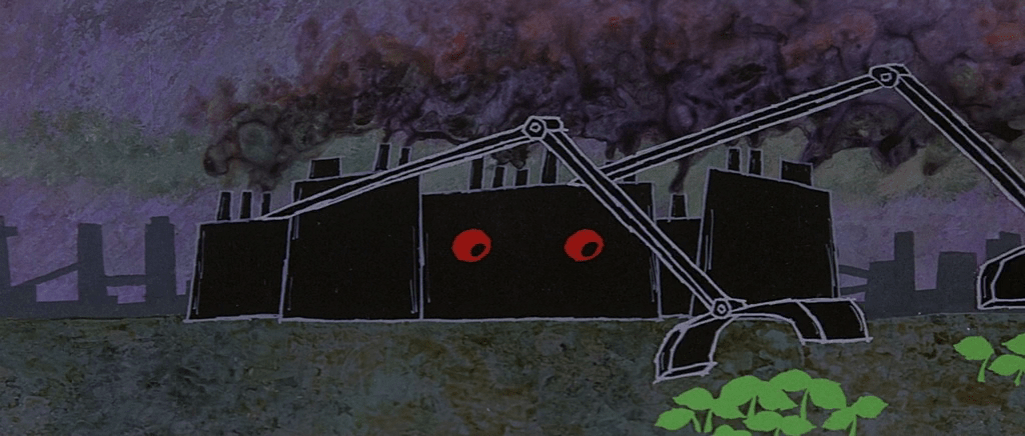
We wonder: what might our shared futures look like if, again, we chose differently? If, instead of solving for the harms of capitalism and tech with more capitalism and tech, we took a different route? Another question for the Arts Department!
LESSON FOR HUMANITY NO. 4 : We are of nature, not separate from it.
In Godzilla vs. Hedorah, there is a groovy-yet-unsettling dance scene in a nightclub in which human dancers’ heads are transformed into fish heads. We take this to signify a lesson we come across repeatedly in the Kaiju archives: we are of nature, not separate from it! Instead of repeating ourselves, we encourage readers to access previous explorations of this lesson in Field Reports 5, 9, and 10.


behold: our fishy selves
Suffice to say: we are not so different from fish.
LESSON FOR HUMANITY NO. 5 : Capitalism—like Hedorah—is not reformable. We must dismantle it piece by piece, and we cannot do it alone.
In the final throes of their fight, Godzilla must “defeat” Hedorah multiple times. Like capitalism, Hedorah is not a single entity. Hedorah is composed of many small toxic pieces of sludge, and it becomes clear over the course of the film that to defeat Hedorah, Godzilla must defeat every single piece of Hedorah.
We cannot help but think of the injustice in expecting Godzilla to defeat this beast of humanity’s making all on his own. We encourage members of the public to revisit Field Report 12, which offers lessons from Kaiju Brooklyn about interdependence and collaboration.
If this lesson feels daunting or unrealistic, we offer wisdom from Geoff Mann. The following is from the chapter titled “Disassembly Required, or, This Will Not Be Easy” in his book called, Disassembly Required: A Field Guide to Actually Existing Capitalism:
“The greatest and most valuable anticapitalist quality right now [is] a willingness and energy to refuse the structural bind of capitalism, to boldly fail, in imagination, analysis, logic, organization, strategy. This requires extraordinary courage, and it is easy to forget that courage generally comes from either having nothing to lose, or from having no real fear of losing.
It is the many people in between, who fear losing what little stability and hope capitalism currently provides, or who believe that capital might yet deliver on its promises, that acquiesce or embrace the rules. Anticapitalists' greatest political task, along with the experiments ongoing and to come, is to reach these folks, to help make sense of their experience in a way that does not belittle their hesitation. These are the people who feel their whole world is on the line; they have good reason for being reluctant to exchange it for what often sounds like empty promises, or worse.
All this requires an inexhaustible determination, for while anything is possible, there is limited time in which to do it. Tireless determination, of course, is not always easy to nurture in one's self or one's friends. But we can take heart in the fact that with no single correct beginning, and no single correct end, even though there is little time, if we try, nothing we do is a waste of it.” - Page 247, Disassembly Required
To move forward in building more just and equitable futures, we must understand how we ended up here, in this version of the present.
If readers take anything away from this Field Report, we hope it is not despair. We hope it is the knowledge that everything happening around us is a result of a set of choices, and we can choose differently! It will take time, and it will be difficult, but it can also be joyful. It can also be fun.
If readers find themselves feeling powerless, we suggest they revisit the sources of power referenced in Field Report No. 12—we all have power. We can build each other up. We are not alone. We hope the public does take our suggestion that they get themselves a little treat. Little treats are a key component of building better futures.
The Kaiju Field Office Team