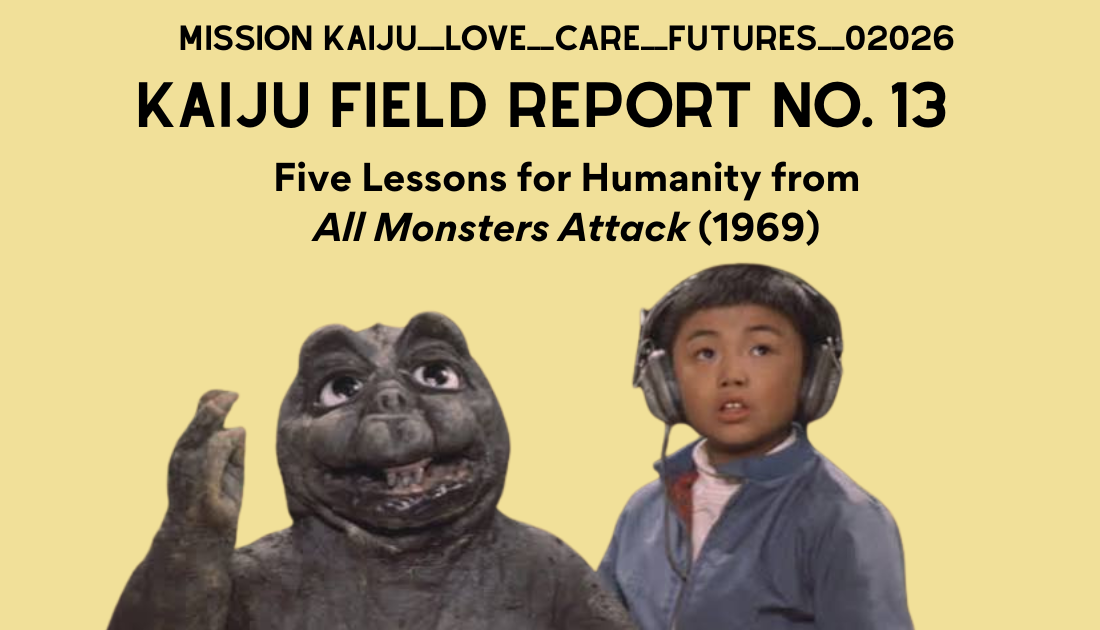
KAIJU FIELD REPORT No. 13
Lessons from All Monsters Attack (1969) about pollution and knowing who the real monsters are, the importance of imagination, the merits of practicing skills, dethroning “innovation,” and a reminder of our capability.
New to the Mission? START HERE: Kaiju Papers Site Index
INCOMING TRANSMISSION / / /
Good afternoon.
We received your memorandum regarding the upcoming strategic planning process and public comment period. While we are relieved that you and Director Stevens have decided to resource this mission with the time and attention necessary for a strategic planning process, we must admit we are a bit reticent.
We would like to propose a few activities that might build trust between Mission HQ, the Field Office, and the Arts Department. In the meantime, as directed, we have disseminated the survey for public comment via this link.
We look forward to this next chapter, and we do hope this newfound confidence in our work results in a new hat for Dr. Tex, (as we have told you on multiple occasions, it was crushed en route to Chicago). We imagine that with a new hat, the Field Office will return to the (somewhat) quiet work environment it once was.
Finally, we would be remiss not to mention that today is Juneteenth. For members of the public who are not familiar with Juneteenth: while the Emancipation Proclamation granted freedom to enslaved peoples across the United States on January 1, 1863, it was not until June 19, 1865 that implementation of this proclamation was fully realized. This is not very “building just and equitable futures” of the U.S. Government, though we must say that just and equitable futures are actually the opposite of what the U.S. was founded on and strives for.
Learn more at the following links, or find your own resources:
- Truthout: Juneteenth reminds us of Black Americans’ long struggle for education following end of slavery
- Southern Poverty Law Center: Juneteenth and the Meaning of Freedom
- National Museum of African American History & Culture: The Historical Legacy of Juneteenth
In the following Field Report, we offer lessons from All Monsters Attack (1969) about pollution and knowing who the real monsters are, the importance of imagination, the merits of practicing skills, dethroning “innovation,” and a reminder of our capability.
KAIJU FIELD REPORT No. 13
- Date: June 19, 02026
- Location: Brooklyn, NY
- Mission: Kaiju_Love_Care_Futures_02026
- Artifacts Examined:
- All Monsters Attack (1969)
- Pages 146 -153: All Monsters Attack, Chapter One of Part One: Beast of Burden: 1954 to 1975 of Ryfle, S., Godziszewski, E., Carpenter, J., Odaka, M., & Tomiyama, S. (2025). Godzilla: The First 70 Years: The Official Illustrated History of the Japanese Productions. Abrams Books.
- Rations Consumed: plant-based babybels, three espresso, leftover Ethiopian food
- Chief of Mission (AKA Dudley the Dog) Present? Yes.
While we have seen that many members of the public consider All Monsters Attack (1969) to be one of, if not the worst of the Godzilla films. We would like to take this opportunity to remind the public that we are scientific future researchers, not film critics, and we quite enjoyed this film.
LESSON FOR HUMANITY NO. 1: Smog, Pollution, and Late-stage Capitalism are the Real Monsters
Ryfle and Godziszewski describe the setting in which All Monsters Attack takes space:
The setting is Kawasaki, a major industrial hub and a symbol of the uneasy trade-offs of rapid postwar growth, blighted by smoky factories and noisy, smoggy, congested highways. Working-class people struggle and strive to make ends meet. Local police search for two bank robbers hiding in the neighborhood.
Against this bleak backdrop, the story follows good-natured but diminutive Ichiro (Tomonori Yazaki), a lonely kid whose parents work long hours and who's routinely harassed by the neighborhood bully.
Minilla is his reflection, a lonely monster boy always pushed around by a big, green, ugly ogre with a hyena laugh. Dreams and reality blur: Ichiro's nemesis and Minilla's tormentor are both called Gabara. - Page 148, The First 70 Years
One of the film’s first images are those of smog and heavy industry. If the imagery wasn’t enough to get us thinking about pollution and environmental racism—the systemic practice of building loud, polluting facilities in communities of color who ultimately bear the greatest brunt of the pollution, with common diagnoses such as cancer, birth defects, and more—the opening song, Monster March, spells it out for us:
The monsters are crying / Why is Earth such a hard place to live? / Go-Go-Godzilla is shocked / Mi-Mi-Minilla is trembling too / Wham! Bang! Crash! / They pulverize everything / But megaton smog and exhaust fumes / They're the real monsters! - Lily Sasaki and the Tokyo Children's Choir
The real monsters are environmental degradation and the systems that profit off of said degradation. What might our shared futures look and feel like if we collectively turned to face these polluting industries and their profiteers head-on?
What might our shared futures look like if we did not treat our more-than-human neighbors with disdain, but worked in collaboration with them and prioritized co-existence instead of domination?
LESSON FOR HUMANITY NO. 2: Imagination is a Key Ingredient of More Just & Equitable Futures
Our protagonist, Ichiro the latchkey kid, imagines his way to Monster Island, where he befriends Minilla (who we first met in Son of Godzilla—members of the public can reference the relevant Field Report here). Ichiro and Minilla deal with bullies, navigate feelings of loneliness and social isolation, and learn how to stand up for themselves (with the help of Father of the Year, Godzilla).
We at the Field Office were struck by how simple, lovely, and subversive this lesson is. In a society that demands productivity, output, and "useful" behavior, imagining new possibilities is one of the most radical things we can do.
When Ichiro traveled to Monster Island via his imagination, it appeared that he was sleeping. Outsiders might think, “what a lazy kid,” when in fact, Ichiro’s mind and heart were working hard to imagine new possibilities! His travels helped him understand that standing up to bullies is possible, and that we can be brave even in the face of fear.
We must be willing to take the time—to appear as though we are doing nothing! To appear as though we are not “producing” so that we have the time and space to imagine new possibilities and to ready ourselves for the work ahead.
While the team was debriefing after our viewing of All Monsters Attack, the man who also lives at the Field Office and tries to sabotage our work chimed in and offered: “Imagination can provide a practicing ground: we must neutralize the bullies in our minds before we can neutralize them in real life.” We had to take a moment to process this and inspect the thought for signs of sabotage, but could find none. Like our colleagues at Mission HQ, the man who lives at the Field Office may be coming around to our work. We knew our collective charm would have an effect eventually.
Journeying through Ichiro’s imagination with Minilla and the other inhabitants of Monster Island brought to mind the works of three thinkers:
In SURVIVA: A Future Ancestral Field Guide, (which presents an earth-based, demilitarized futuredream that foregrounds indigenous knowledge as critical to humanity’s survival), Cannupa Hanska Luger reminds us:
“Revolution involves destruction through the creation of an alternative that renders something obsolete.” - Page 57, SURVIVA
In How to Fall in Love with the Future: A Time Traveller’s Guide to Changing the World, Rob Hopkins outlines what happens in our brains when we imagine the future:
“Researchers have long understood that each time we formulate a memory, our brains reconstruct those memories afresh; each instance represents a uniquely assembled combination of what's stored in our cupboards. This allows us to update our memories, making them more relevant to our current self, our current situation and our current beliefs, essentially editing our memories to make them more acceptable to who we are now? Rather than being static and untainted, our memories are constantly chang-ing, as our brains bring recollections of past experiences into line with real-time goals, self-image and self-beliefs.
A more recent revelation, however, is that something similar happens when we imagine the future: we create that thinking afresh each time. According to Donna Rose Addis, a professor at the University of Toronto who specialises in perception, cognition and cognitive neuroscience, "When you're constructing this simulation, you're essentially constructing a model of reality." Addis added that when you imagine the future, the parts of your brain that kick in are the same parts that kick in when you read fiction or are engaged in similar imaginative activities.” - Page 32, How to Fall in Love with the Future
Frank W. Spencer of The Futures School and Friend of Mission Kaiju_Love_Care_Futures_02026 outlines his definition of imagination:
You may think that imagination is simply the cognitive capacity to form images that are not present to the physical senses, but as French philosopher Henry Corbin noted, "The imaginal realm, or Mundus Imaginalis, is not an inner world projected on our relationships... it is rather (a) 𝘱𝘴𝘺𝘤𝘩𝘪𝘤 𝘳𝘦𝘢𝘭𝘪𝘵𝘺 that envelops people and which structures their mutual presence." Philosopher Jonathan Rowson calls the imaginal realm "a 𝘳𝘦𝘢𝘭 place," and imagination expert Eleanor Robins says that imagination is "expanded dimensions of reality" that desire to break into our ways of knowing, sensing, feeling, intuiting, and embodying. This has profound implications for the way we approach our world, our futures, and life itself. - Frank W. Spencer
LESSON FOR HUMANITY No. 3: Practice Makes Practiced
When Godzilla fights Kumonga (a very large spider-like strange beast), Minilla tries to help by using his radioactive breath. Not yet strong enough, Minilla’s efforts result in a single radioactive ring instead of a strong beam like Papa Godzilla’s.
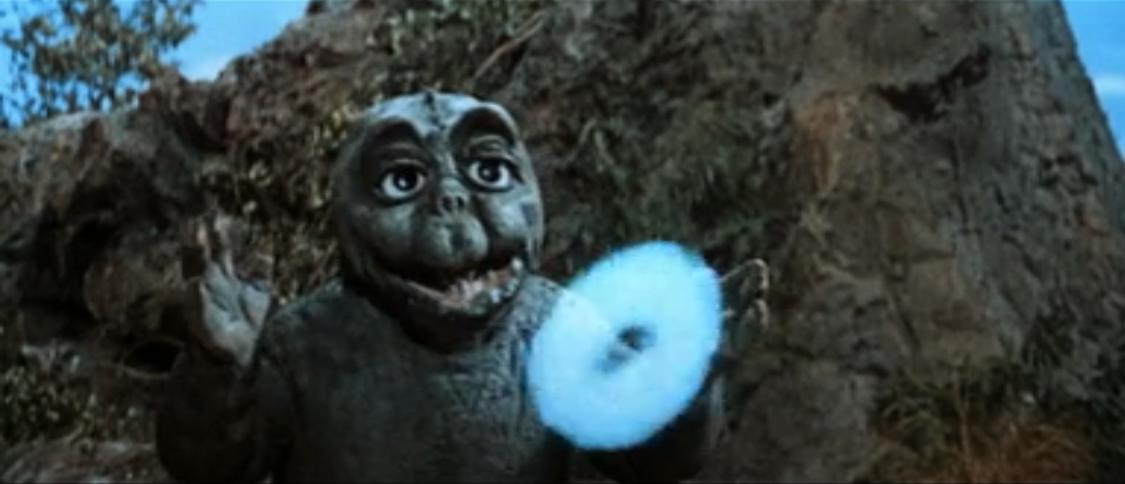
Minilla runs back to Ichiro for safety. Ichiro says, “You’re still not ready for that!” Minilla responds, “yeah… but even Godzilla couldn’t do it at first. He had to practice a lot.”
None of us are born knowing how to fully deploy our radioactive breath (or equivalent skills such as riding a bicycle, baking macarons, or navigating interpersonal conflict). Just like Godzilla and Minilla, we must practice! We must be willing to get things wrong, often, before we can consider ourselves fully practiced. We offer “practiced” here because perfection is an unattainable myth that serves no one but the ruling class.
We are always growing, adapting, and learning. This is a part of being alive!
LESSON FOR HUMANITY No. 4: We do Not Need to Reinvent the Wheel
Modern capitalism is obsessed with innovation and the novel. People jockey for power and recognition through “innovation” and “disruption.” We don’t need more new things or inventions (especially when so many of them are things like autonomous weapons and robot police dogs).
We must remember! Remember what works, remember what has worked for many years.
In our view, the “things that work” are community, solidarity, and living in right relationship to land, people, and our more-than-human neighbors. All Monsters Attack is an excellent example of building on existing knowledge and practices to tell a new story. Ryfle and Godziszewski give us some background:
“The end of the drive-in era and changes in the American film market reduced opportunities for overseas coproductions and distribution. As the studio resumed the Godzilla series, it pivoted to a more economical and child-focused approach. … in the fall of 1969, screenwriter Shinichi Sekizawa proposed a different style of Godzilla movie—a children's fantasy repurposing monster scenes from prior films, thus requiring a very low budget. The project was fast-tracked, and the movie began shooting on October 11, 1969, to be released just over two months later.” - Page 150, The First 70 Years
We at the Field Office are sitting with a thought offered by Egg while working on this Field Report: “You can change any story by repurposing scenes and editing them as you wish. How many permutations or versions might exist of this exact footage? The outcome depends on how you edit the frames together, what music you choose, and your mood. How many versions of this movie might there be, out in the ether? Who knows? There might be a completely different, darker version of this film! There might be a similar version where the only difference is Ichiro’s hat is orange and not yellow!”
…Egg got into some of the drugs left out by the man who also lives at the Field Office. While we appreciate his insight we mentioned earlier, we believe this may have been an act of sabotage. We might need to go to the emergency vet. We will send Director Stevens the bill.
LESSON FOR HUMANITY No. 5: You are Capable! All Right, Baby!
Ryfle and Godziszewski take us home:
“...All Monsters Attack ends with optimism and hope. As strict-but-caring daddy Godzilla teaches Minilla to fight like a monster, Ichiro also learns to fend for himself. Kidnapped by the crooks, the boy bravely fends them off and escapes, leading to their arrest. He becomes a local celebrity for solving the crime and heroically dispenses with the local bully.” - Page 153, The First 70 Years
Like Ichiro and Minilla, you too are capable. Keep practicing whatever it is you need to practice. Practice imagining. Practice your radioactive breath. Practice believing a better future is possible. Spend time with your friends, whether they are Kaiju or not, and cheer each other on.
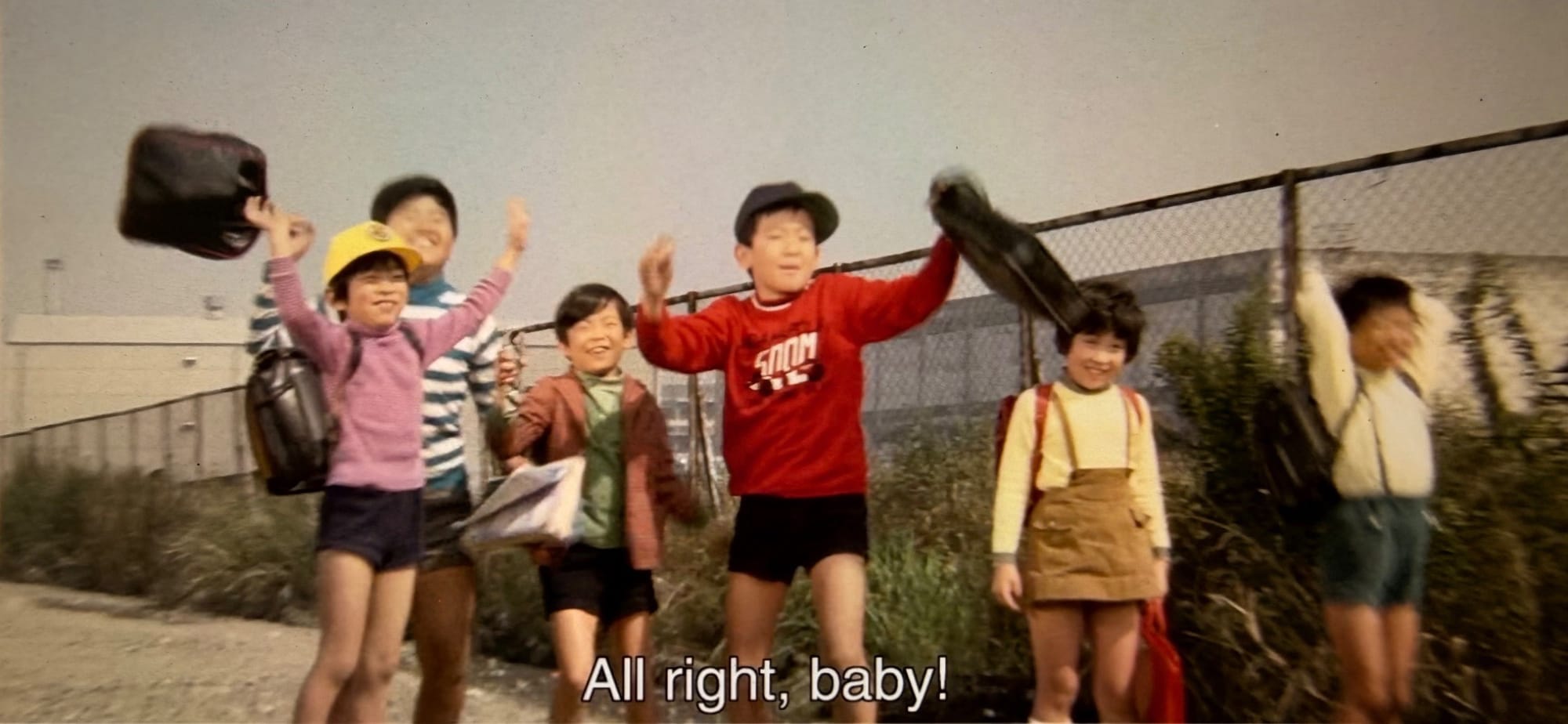
Rations are well-stocked, though the Chief of Mission could use more blueberries. Morale is high—we are looking forward to whatever the new chapter of The Kaiju Papers brings!
The Kaiju Mission Field Office Team
P.S. Whether you and Director Stevens like it or not, we will be producing a Field Report outlining the lessons in Boots Riley's I Love Boosters, seeing as we are convinced that it is a Kaiju film that helps us imagine and therefore build more just and equitable futures. We encourage members of the public who love the future to go see it in theaters posthaste.